Language
Nourishment
Living ExpressionThe field builds itself from its environment. Kitchen-hearth is the center. Meals are resonance practice. Like campfire that shaped every tribe.
The field builds itself from its environment. Kitchen-hearth is the center. Meals are resonance practice. Like campfire that shaped every tribe.
The Feeling
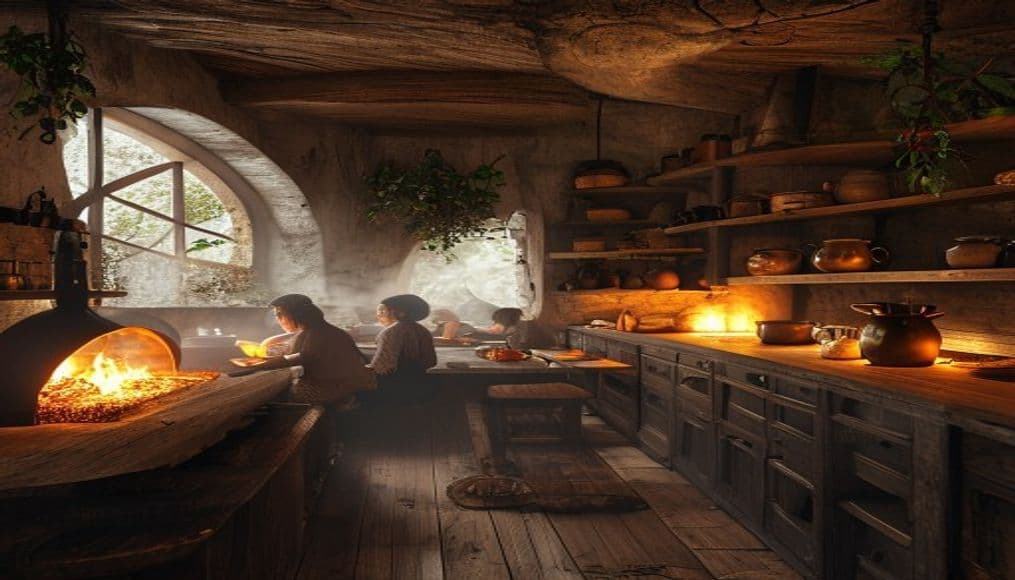
You smell it before you see it. Walking the path from the garden with soil still under your fingernails, the wind shifts and carries woodsmoke, garlic, bread. Your stomach doesn't growl -- it hums. Something deeper than hunger: the recognition that what the land grew is becoming what the community will share, and your body is about to join that circuit. The kitchen pulls you the way a campfire pulls every human who has ever lived. Four hundred thousand years of gathering around flame, and your cells remember all of it.
You step into the Hearth. Steam rising from the big pot. Someone is pulling bread from the clay oven -- the sourdough that was fed three days ago from a starter that's older than the community itself. A child stands on a stool stirring something, face serious with concentration. Three people are chopping what was picked an hour ago: the last tomatoes of the season, heavy and warm from the vine, splitting open at the knife with a sweetness you can smell. No one assigned these roles. The kitchen organized itself the way water organizes into a river -- by finding the path of least resistance through willing hands.
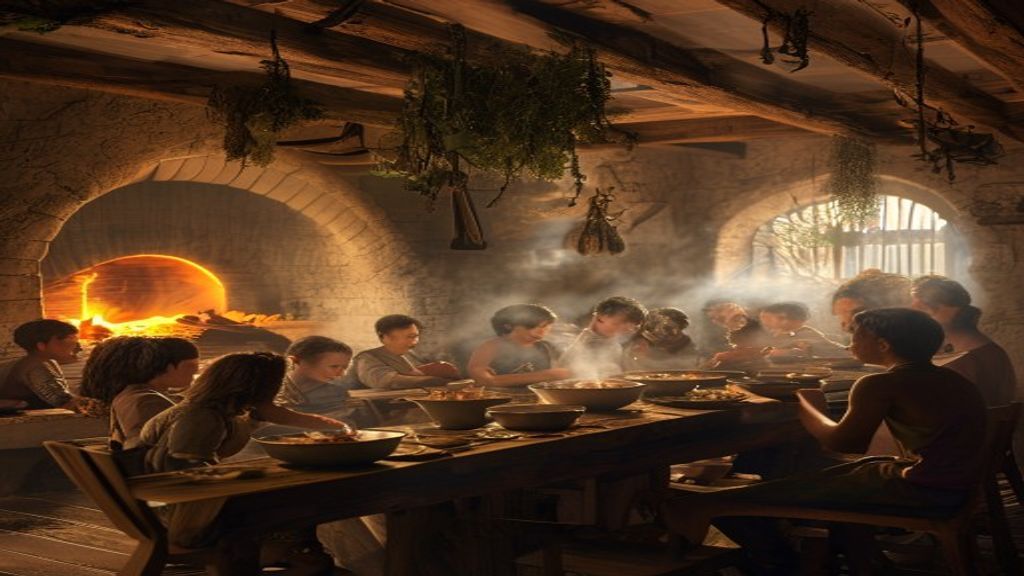
You sit at the long table. Forty people, some still arriving, some already eating. The food is passed, not plated. You serve the person beside you before yourself -- not as rule but as instinct. The first bite is a conversation between your body and the land: this soil, this rain, this sun, this season, these hands that tended it. You are eating the place you live. You are becoming it.
How It Lives Here
Meals follow the land. In spring, the menu is tender: the first asparagus, young greens, sorrel, radishes. You eat lightly because the land is giving lightly. Summer explodes: tomatoes in every color, peppers, squash cascading from the vine, stone fruit dripping with juice. Autumn turns inward: root vegetables, apples, the great preservation season when the kitchen fills with the smell of canning and smoking and drying. Winter is the gift of all that storing: fermented cabbage, dried herbs, smoked fish, root cellar potatoes, and the sourdough bread that connects every week to every other week through the living starter.
The fermentation corner is the quietest miracle. Rows of glass jars on wooden shelves against the cool north wall, each one a civilization. The sauerkraut is a collaboration between human hands and lactobacillus -- you shredded the cabbage and salted it, and then you stepped back and let a billion organisms do what they've done since before humans existed. The sourdough starter is fed every morning by whoever wakes first. The miso is ripening in ceramic crocks, transforming slowly over months. Fermentation IS community at the microbial scale: diverse organisms in relationship, each doing its work, the result greater than any individual contribution. Every jar on that shelf is a mirror.
What Nature Teaches
The campfire is humanity's original technology. Not the wheel, not the spear -- the fire. Cooking food externally freed metabolic energy for brain development. Gathering around the fire created the first social architecture: a circle of light in the darkness, faces visible to each other, stories exchanged while food transformed. The kitchen-hearth is not a design choice. It's a return to what made us human.
A forest feeds itself through death. Leaves fall, fungi digest them, nutrients return to the soil, roots absorb them, new leaves grow. Nothing is wasted. Nothing is imported. The community's food system aspires to the same closure: compost from the kitchen feeds the garden, the garden feeds the kitchen, the scraps feed the compost. The circle tightens year by year until the boundary between "waste" and "food" dissolves entirely.
The Korean tradition of kimchi-making -- kimjang -- is a communal event. An entire neighborhood gathers in late autumn to chop, salt, spice, and pack hundreds of heads of cabbage. The hands that touch the food become part of its culture -- literally. The microbiome of your skin seeds the ferment. Nourishment as communion is not a metaphor. It's microbiology.
Embodied Now
Nourishment does not wait for six acres and a mature food forest. It begins the moment a kitchen, hall, porch, or pantry keeps its physical shape but sheds its old assumptions: meals are no longer private cleanup burdens, schedules are no longer optimized for isolation, and food becomes a shared rhythm again.
In a city building. One floor shares a weekly meal, a common pantry shelf, and a fermentation fridge. The first infrastructure is not a farm. It is a table people can count on.
On an urban block. A church kitchen, storefront kitchen, or community hall opens one public meal night, one soup-and-repair afternoon, one bread cycle. The neighborhood begins trusting the place because food is visible there.
On a suburban lane. Several homes rotate school breakfasts, preserve together in autumn, and keep one garage pantry for staples that no household needs to carry alone. The lane starts tasting like a commons before it looks like one.
On rural land. A house, greenhouse, or barn kitchen becomes the anchor where produce, preserves, seed starts, herbal knowledge, and guest meals flow through one warm center. The field becomes believable because you can smell it before you understand it.
Where You Can See It
Satoyama, Japan -- centuries-old mosaics of forest, rice paddy, vegetable garden, and fish pond. Human cultivation increased biodiversity. The paddy fields became habitat for frogs and herons. Food production as relationship, not extraction.
Oaxacan milpa, Mexico -- the Three Sisters: corn, beans, squash planted together for seven thousand years. Corn provides a pole for beans. Beans fix nitrogen for corn. Squash shades ground, holds moisture. Three species in mutualism producing complete protein and ecosystem service. The original food forest at human scale.
A grandmother's kitchen, anywhere -- where the stove is always warm, something always simmering, you are fed before you know you're hungry. This kitchen knows: nourishment is not nutrition. Nourishment is the whole act -- growing, preparing, sharing, receiving, composting, growing again.
What We're Building
A community of fifty can feed itself from six acres of well-designed land: two acres intensive annuals, two acres food forest, one acre grain, plus livestock and ponds. The food forest takes five to seven years to reach full production, but annual gardens feed you from month three. By year seven, a mature ecosystem produces more food than you can eat, with labor measured in hours per week rather than hours per day.
The kitchen-hearth seats forty at one table, with a wood-fired clay oven that bakes twenty loaves at once and rocket stoves that burn eighty percent less fuel than open fire. The fermentation corner, the root cellar, the drying racks and canning shelves -- these are the technologies that turn summer's abundance into winter's security. Two hundred pounds of sauerkraut, a hundred pounds of kimchi, and fifty pounds of miso put up each autumn in two afternoons of communal chopping. Forty laying hens producing eggs for breakfast, three to six beehives pollinating the food forest and yielding honey, and eventually dairy goats whose milk becomes cheese. The first-year budget is $340-795 per person. By year three, ongoing food costs drop to $100-200 per person per year.
Practical guide: How to actually do this
Resources
- One Community - Transition Kitchen -- open-source community kitchen for 50+ (type: blueprint)
- Andrew Millison - Permaculture -- free 28-chapter textbook (type: book)
- ATTRA -- 300+ free publications on organic farming and preservation (type: guide)
- Wild Fermentation by Sandor Katz -- definitive home fermentation (type: book)
- Edible Forest Gardens -- comprehensive food forest design (type: book)
- PFAF -- 7,000+ edible/useful plants searchable by zone (type: database)
The Questions That Live Here
- When was the last time you ate something you grew with your own hands? What did it taste like?
- Is there a difference between feeding someone and nourishing them?
- What would change if you could only eat what grew within walking distance?
- Can a meal be a ceremony? When does eating become communion?
- At what point does the garden stop feeling like work and start feeling like conversation?
Influences and connections
Listening for voices…
Connected Frequencies
The people, places, works, and concepts the graph shows connected to this one.