Language
Living Spaces
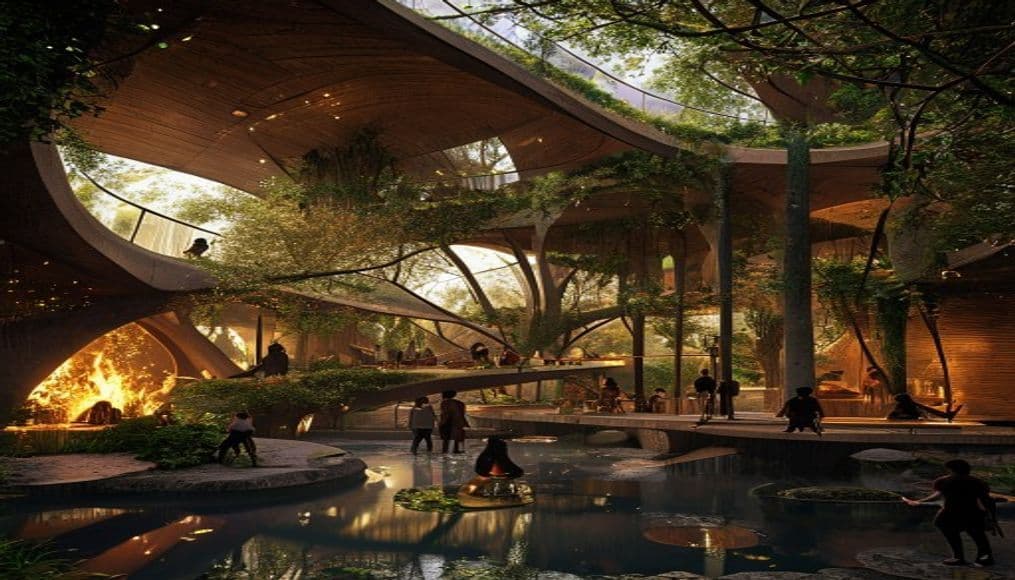
Living ExpressionShelter from frequency and flow. Not rooms — resonance zones. Structures that breathe, grow. Beehive, coral reef, tree canopy.
Not rooms — resonance zones. Structures that breathe, reconfigure, grow, and eventually return to the earth they came from. The shape follows what is alive now.
The Feeling
You step through the doorway and there is no threshold — the porch was already half-outside, the courtyard was already half-inside, and this room continues the gradient. The walls are earthen, hand-plastered, and they curve. No corners. The floor is warm stone that spent the day absorbing sunlight and is now giving it back through the soles of your feet. The ceiling is high enough to breathe in, held up by roundwood timbers still wearing their bark, and through the skylight you can see the living roof where grasses are moving in the wind.
You realize you have been holding your shoulders near your ears for years. In this room, they drop. Something about the curves, the warmth radiating from below, the smell of clay and wood and the green things growing on the roof — your nervous system reads it all and decides: safe. Not the safety of locks and alarms. The safety of being held by something alive.
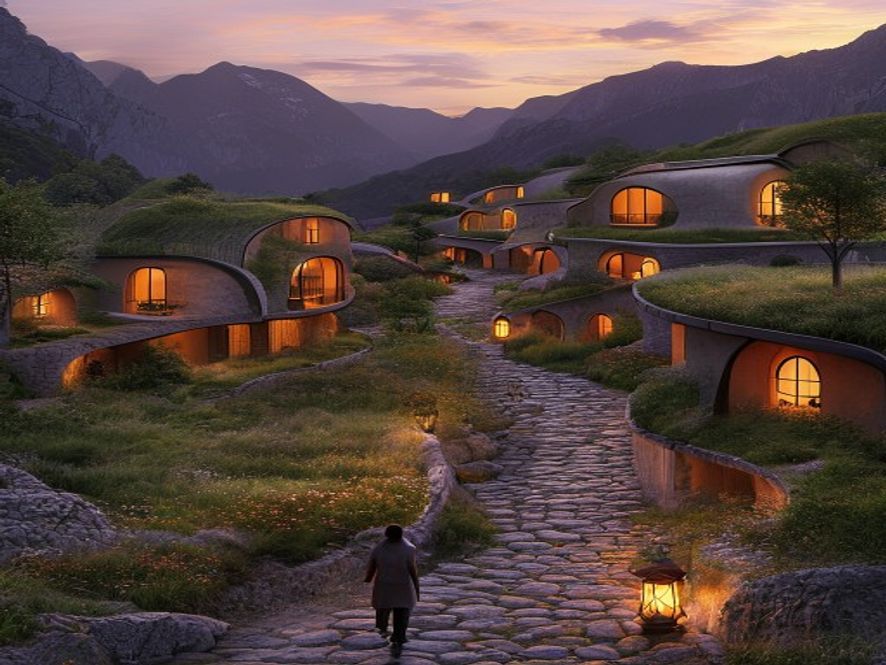
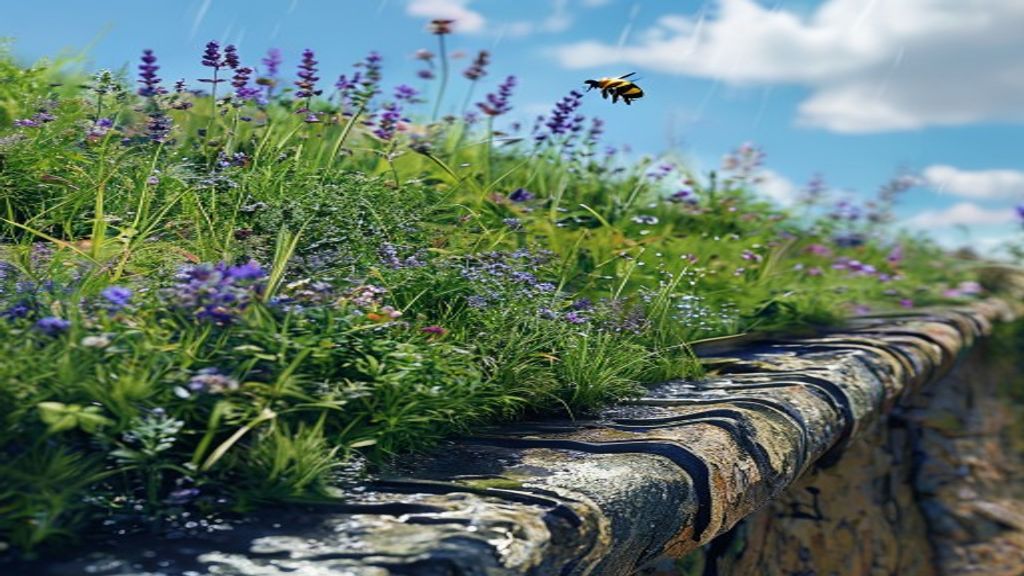
Outside, the path curves between buildings that look less like architecture and more like something that grew here. Because in a sense they did. The cob walls rose from soil dug on site. The timber came from trees thinned from the forest a mile uphill. The roofs are planted with the same wildflowers that grow in the meadow. In twenty years these buildings will look ancient. In two hundred years, if no one maintains them, they will become a hill. The materials remember how to be earth.
How It Lives Here
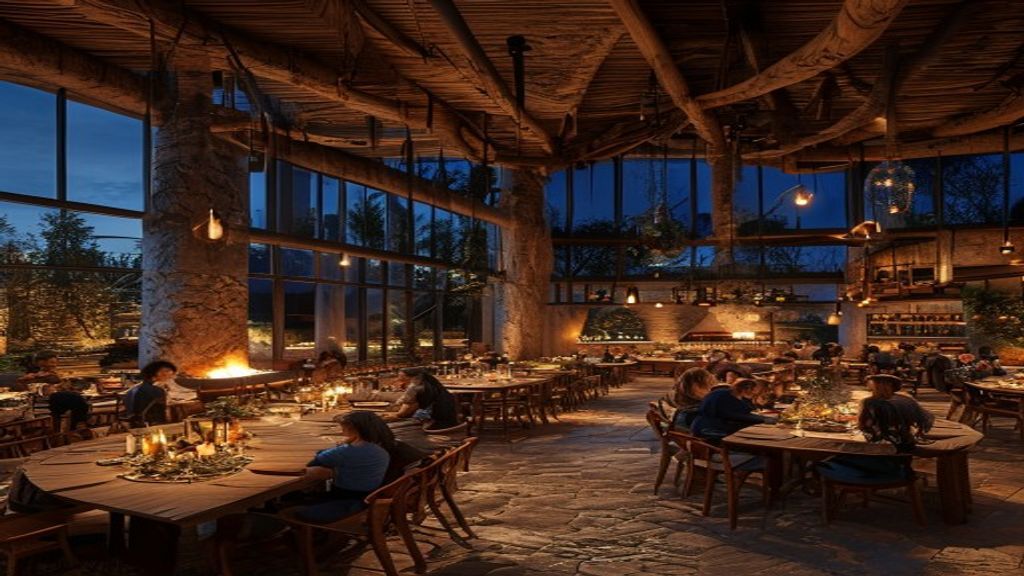
Spaces here are named by the quality they hold, not the function they serve. The Hearth is where meals happen and stories are told and arguments dissolve over shared bread — a large open room with a wood fire, long tables, and herbs hanging from the ceiling. The Sanctuary is always quiet, always open, its curved walls softening sound into a hush that makes your breathing slow. The Nest is where you sleep — a small private space, two hundred to four hundred square feet, just enough for a bed and a shelf and a window that frames the sky.
The inside-outside gradient is deliberate. Between the Hearth and the garden there is a covered porch with a hammock and climbing jasmine. Between your Nest and the path there is a screened alcove where you can sit in rain without getting wet. There is no moment where you are suddenly inside or suddenly outside — the transition is continuous, like wading into water instead of jumping off a dock.
Spaces reconfigure. Sliding panels and woven curtains let a room that held morning movement practice become the afternoon workshop. The clearing — an outdoor circle of packed earth and low stone seating — holds ceremonies, meetings, dances, and on some evenings, nothing at all. The buildings are not finished. They are never finished. A new alcove appears when someone feels the need for one and spends a week with clay and water and straw.
Planning means something different here. It does not mean forcing a fixed future onto a site. It means sensing the field clearly enough to place the next wall, open the next threshold, or leave the next patch empty because emptiness is what the organism needs today. Memory matters. Vision matters. But the active instruction is always in the now.
What Nature Teaches
A beehive is a building made by its inhabitants from their own bodies — beeswax secreted, chewed, shaped into hexagonal cells that are structurally perfect and thermally regulated by the collective warmth of thousands of bees. The hive breathes. It adjusts. When a section is damaged, the swarm repairs it. The architecture and the organism are the same thing.
A coral reef grows from the accumulated skeletons of billions of tiny animals, each one adding its small calcium contribution to a structure that becomes home for thousands of species. The reef is not designed. It emerges. And it is more complex, more resilient, more beautiful than anything a single mind could plan.
The living root bridges of Meghalaya, in northeast India, are perhaps the most literal example. The Khasi people train the aerial roots of strangler figs across rivers and ravines, weaving them into bridges that strengthen with age. A root bridge takes fifteen to thirty years to become walkable. It lives for five hundred. It does not rot. It does not rust. It grows stronger every year because it is alive. The bridge IS the tree.
Where You Can See It
In Taos, New Mexico, the Earthship Biotecture Academy teaches people to build homes from recycled tires, bottles, and earth — structures that heat and cool themselves, catch their own water, grow their own food, and generate their own power. You can stay in one. The walls are three feet thick and the temperature never drops below sixty degrees, even in a mountain winter, without any heating system at all.
At the Green School in Bali, IBUKU has built cathedral-scale structures entirely from bamboo — a grass that grows to harvest size in three years. The buildings soar, curve, breathe. They prove that natural materials are not a compromise. They are what becomes possible when you stop forcing straight lines onto a world that grows in spirals.
In Vienna, the Hundertwasser buildings have trees growing from windows, undulating floors, facades painted by tenants, and not a single straight line in the entire structure. Hundertwasser called the straight line "the devil's tool." He was not wrong. Walk through his buildings and your body relaxes in a way that right angles never permit.
How Existing Structures Change
This vision does not require waiting for untouched land. It can move through the structures that already exist.
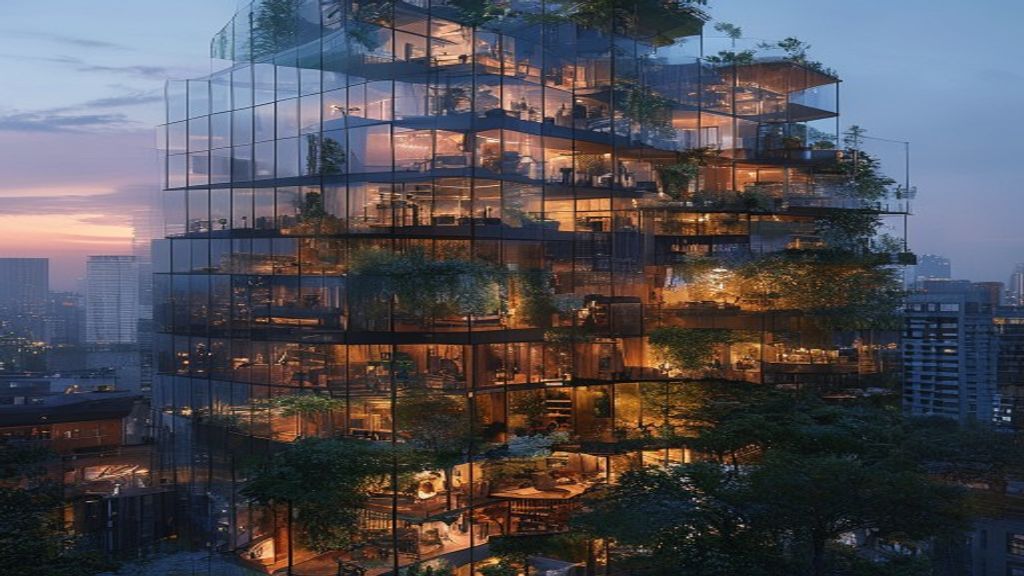
The understanding deepens when attuned spaces become visible as their own layer. The future is not only fresh cob villages on open land. It is also apartments becoming coherent cells, suburbs loosening into villages, town infrastructure remembering that it is shared, and towers learning how to breathe.
The skyscraper becomes a vertical village. Floors stop being rentable compartments and become community layers. One floor is a quiet band of nests and recovery rooms. Another becomes a nourishment hall with a shared kitchen, fermentation wall, and long table. Another becomes a maker floor. Another holds children, tutors, elders, and music. Roofs become gardens and wind catchers. Elevators stop being commute tubes and become circulation organs moving people between states of activity.
The shopping street becomes a provision corridor. What used to be stores become provision houses, material commons, seed libraries, repair ateliers, fitting rooms for shared clothing, and exchange counters where things move because they are needed, not because they were pushed into demand.
The restaurant becomes a nourishment hall. No one performs service for tips. People arrive to receive the meal of the day, help plate, sit at long tables, and leave more regulated than when they entered. The kitchen becomes visible, the fermentation becomes visible, and the ritual of gratitude becomes part of digestion.
The office lobby becomes a threshold chamber. Instead of advertising, branding, and throughput, it regulates arrival: sound softened, bodies slowed, the day's field made visible, and the next layer of activity chosen by present resonance rather than calendar compulsion.
What We're Building
For fifty people, the community needs seven named spaces. The Hearth at two thousand square feet — kitchen, dining, gathering, the organism's heart. The Sanctuary at eight hundred feet — silence, rest, healing. The Workshop — tools, materials, making. The Spring — water, bathing, sauna. Fifteen to twenty private Nests. A Movement Ground outdoors. And the Clearing — the open circle that belongs to everyone and no one.
Every structure is built from what the site offers. Subsoil for cob walls. Timber thinned from the forest. Stone from the stream bed. Living roofs planted with seed gathered from the meadow. The buildings cost a fraction of conventional construction — not because they are lesser but because the most expensive part of a building is usually the distance its materials have traveled. When the walls are made of the ground beneath your feet, that distance is zero.
Materials are chosen for how they age. Lime plaster develops a patina. Timber silvers. Earthen floors burnish with use. Nothing here is meant to look new forever. Everything is meant to look more beautiful with time, the way a face looks more beautiful with time, the way a stone in a river looks more beautiful with time.
And when a building finally reaches the end of its lifecycle — decades from now, maybe a century — it composts. The cob walls dissolve back into the hillside they came from. The timbers become nurse logs for the next generation of forest. The stones return to the stream bed. Nothing is demolished. Everything is returned. The building was always borrowed from the land, and the land always gets it back.
Resources
- A Pattern Language Index — searchable Christopher Alexander 253 patterns (type: book)
- Open Building Institute — open-source modular eco-building with free CAD library (type: blueprint)
- One Community - Open Source Village — complete village blueprints for 7 sustainable community types (type: blueprint)
- Foundation for Intentional Community — directory of 1000+ intentional communities with design resources (type: community)
The Questions That Live Here
- How do you design for both the person who needs solitude and the person who needs company — in the same community, on the same day?
- What is the right ratio of private to common space? Cohousing research says fifteen to twenty-five percent common. Does that feel right?
- How do you let spaces evolve as the community grows, without overplanning the future or underbuilding the present?
- When a building reaches the end of its life, how do we celebrate that composting rather than mourn it?
Influences and connections
Listening for voices…
Connected Frequencies
The people, places, works, and concepts the graph shows connected to this one.