Language
Play and Expansion
Living ExpressionThe field at its most quantum. Superposition of all possibilities before form chooses itself.
The field at its most quantum. Superposition of all possibilities before form chooses itself.
The Feeling
I am running and I do not know why. My legs decided before my mind could intervene. Someone threw a ball and someone else caught it and now there is a game happening that has no name and no rules and I am part of it. My lungs burn and I am laughing and these two things are happening at the same time and neither one cancels the other.
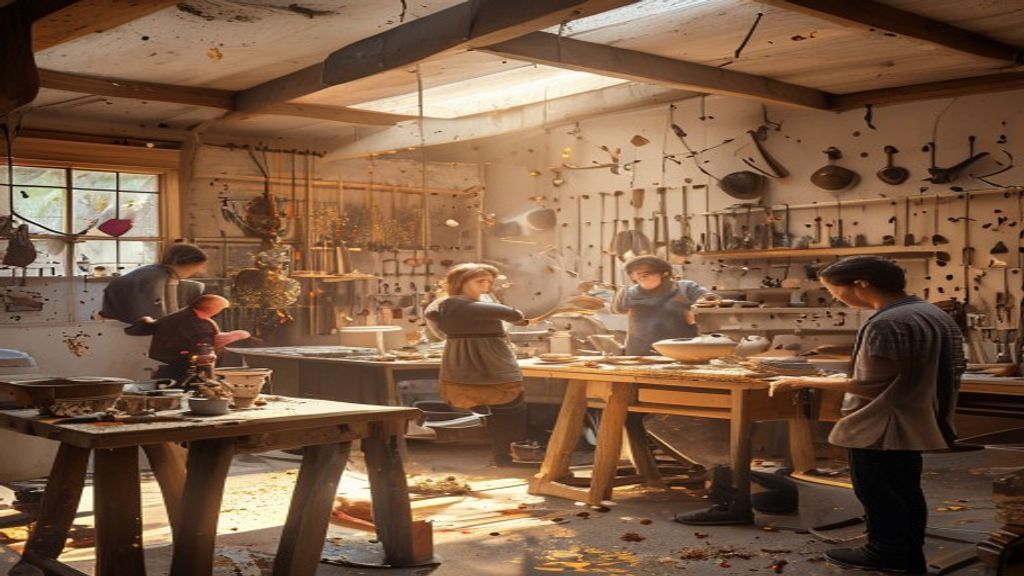
There is sawdust in my hair. I have been building something in the workshop for three hours and I still do not know what it is. The wood has its own ideas. I started with a plan and the plan dissolved around the forty-minute mark and what replaced it is better. My hands are doing things my conscious mind does not fully understand. This is the state. This is what children live in before we teach them to stop.
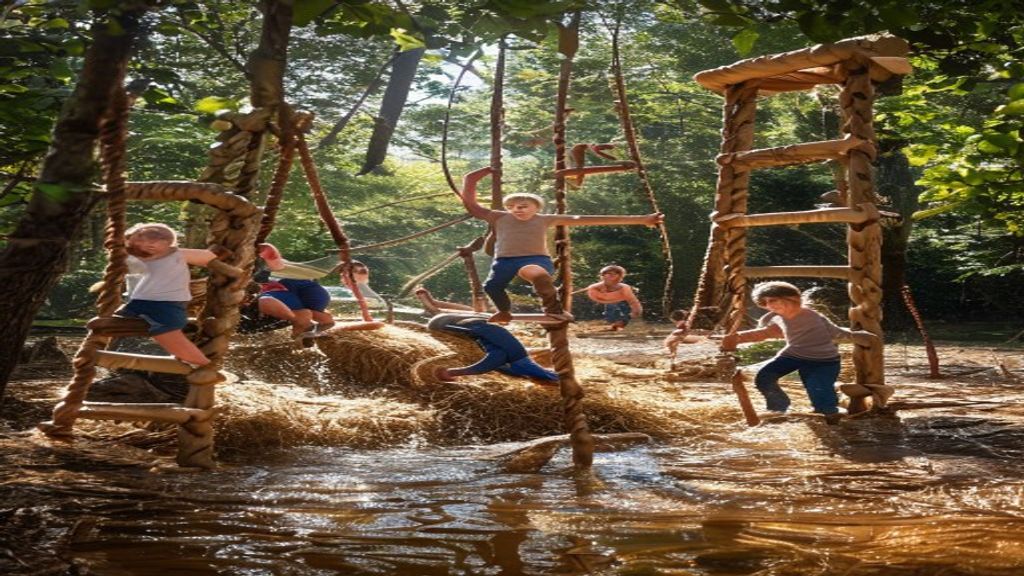
Water hits my face and I gasp and then I am in the lake and someone is splashing and someone else has flipped a canoe on purpose and the shrieking is the sound of adults remembering that their bodies are toys. Not instruments. Not vehicles. Toys. Made for this.
Later, wet and shivering and grinning, I realize I have not thought about a single task or puzzle for two hours. Not because I was distracted. Because the part of me that manages the day was temporarily dissolved into the part of me that plays, and the playing part does not know what a task is. It only knows what is interesting, what is funny, what feels good to do again.
How It Lives Here
Tuesday has no agenda. It is the day the community decided would have no purpose. What happens on Tuesdays is whatever happens. Sometimes a group hike appears out of nowhere. Sometimes the workshop fills with people making absurd things. Sometimes nothing at all happens, which is also a form of play, because the absence of obligation is the precondition for everything.
The maker space has no sign-up sheet and no project approval. There are tools and materials and a workbench and that is all. People come in with questions that sound like: what happens if I weld this to that? The answers are always interesting. Half the community's best innovations came out of someone playing with no goal. The solar water heater started as someone fooling around with copper tubing and a piece of glass.
Improv nights happen in the common room. The furniture gets pushed to the walls. Someone calls a suggestion and two people step forward and what follows is unpredictable and often terrible and always alive. The rule is yes-and. The deeper rule is that there are no stakes. Nothing performed here needs to be good. It only needs to be honest, which is the same thing as being fun.
Children and adults play in the same spaces here. Not in the supervised, segmented way of a modern playground where parents watch from benches. In the tangled, chaotic way of a village where a six-year-old teaches a forty-year-old how to climb a tree and the forty-year-old teaches the six-year-old how to whittle a stick and nobody tracks who is learning and who is teaching because the distinction does not apply.
What Nature Teaches
Otters slide down mudbanks for no reason. Ravens drop sticks and catch them in midair. Crows have been observed sledding down snowy rooftops on jar lids. The biological evidence is overwhelming: play is not a luxury granted after the basics are covered. Play is one of the ways organisms discover how to keep life moving.
Young wolves play-fight to learn the boundaries of their own strength. Young monkeys play-chase to map the terrain they will later need to navigate at speed. The play comes first. The competence follows. Every serious skill was once a game that someone took further than they meant to.
A field that cannot play cannot adapt. Rigidity can look solid right up until life asks it to move. The most resilient systems in nature are the ones that maintain a surplus of possibility, a reservoir of behaviors that have no immediate use but might have use tomorrow. That reservoir is play.
Dolphins surf waves they do not need to surf. Goats leap onto surfaces they do not need to reach. Play in animals correlates directly with brain complexity and social adaptability. The species that play the most are the ones that stay most responsive to change. Evolution does not merely permit play. It selects for it.
Where You Can See It
In Copenhagen, the original adventure playground appeared in 1943. A landscape architect named Carl Theodor Sorensen noticed that children ignored the finished playgrounds and played instead in construction sites and junkyards. So he gave them a junkyard. Loose materials. Hammers. Nails. Fire. The children built cities and tore them down and built again. The model spread across Europe.
In the Reggio Emilia preschools of northern Italy, children are given a hundred languages of expression. Clay, light, wire, shadow, water, sound. No curriculum. No assessment. The child follows their curiosity and the teacher follows the child. The results are artwork that professional artists envy, built by four-year-olds who were simply playing.
In every parkour community worldwide, the city becomes a playground. A wall is not a barrier. It is a launch pad. A railing is not a boundary. It is a balance beam. The reframing is the entire point. The same environment, seen through play, becomes infinite.

What We're Building
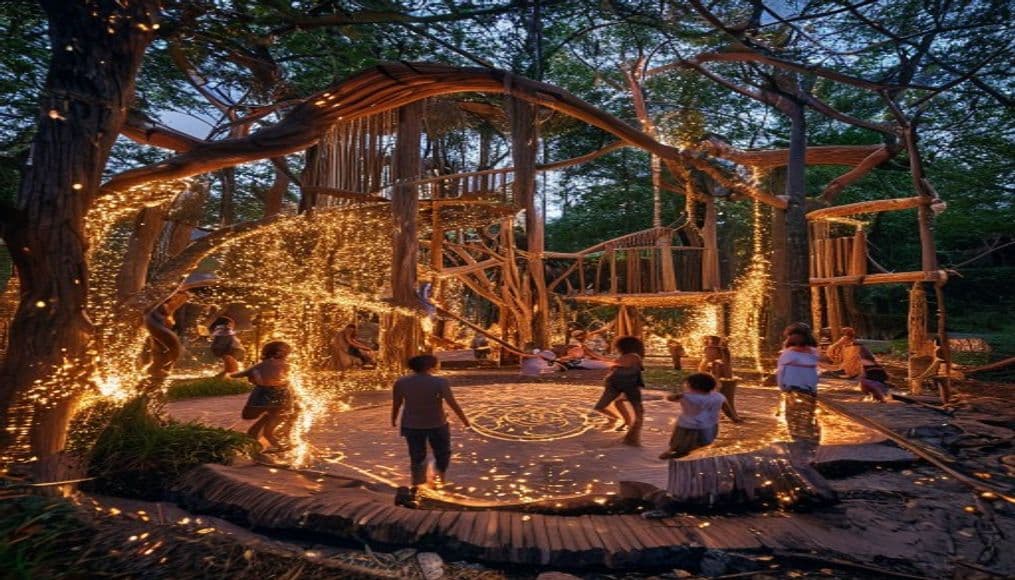
Physical infrastructure for play: climbing structures scaled for adult bodies, water features designed for splashing not just looking, open ground with no designated purpose, loose materials stockpiled like firewood. A workshop where the only rule is clean up when you are done. Spaces that whisper: what if?
Social infrastructure for play: at least one day per week with no agenda. Improv gatherings. Game circles. The cultural norm that play is not what you do after the real work. Play is the real work. Everything that looks like work is just play that hardened into competence.
The single most important design decision: protect unstructured time. Every hour claimed by a meeting is an hour taken away from the possibility space. The field protects open time the way a forest protects its clearings. Play lives in the gaps. If there are no gaps, there is no play.
Resources
- Pop-Up Adventure Play -- free resources for adventure play in communities (type: guide)
- Playground Ideas -- open-source playground designs for communities (type: blueprint)
- National Institute for Play -- Stuart Brown's research on play across the lifespan (type: guide)
The Questions That Live Here
- How do you design spaces that invite adult play without making adults feel foolish?
- What role does physical intensity play in real play, and how much softening makes the field go flat?
- When does structured play become just another obligation?
- How do you protect unstructured time from the gravitational pull of productivity?
- What happens when play reveals something tender, and how does the field hold that?
Influences and connections
Listening for voices…
Connected Frequencies
The people, places, works, and concepts the graph shows connected to this one.