Language
Energy Metabolism
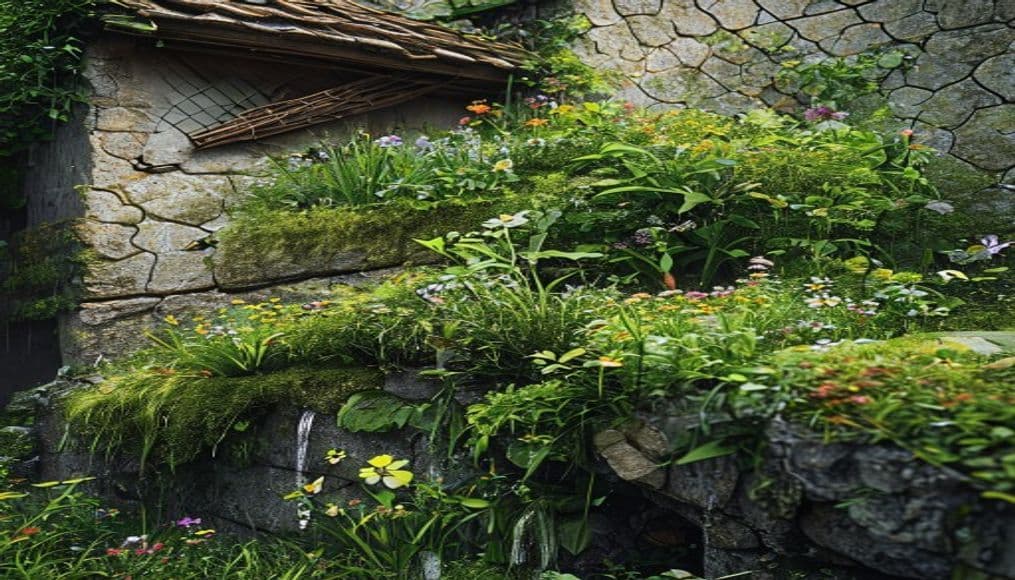
Living ExpressionThe field's metabolism. Like a mature forest: net producer. Energy is stored only where buffering benefits the organism; everything else stays in flow.
The field's metabolism. Like a mature forest: net producer. Energy is stored only where buffering benefits the organism; everything else stays in flow.
The Feeling
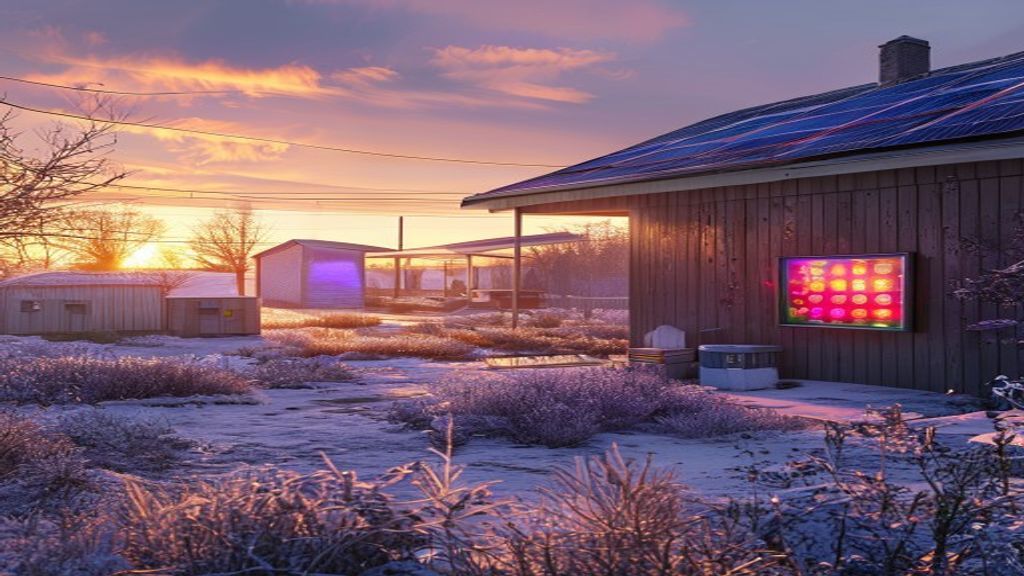
Late afternoon in January. The sun is low but the south-facing array is still pulling in current -- you can feel it if you stand near the inverter shed, a faint hum that has become as familiar as your own heartbeat. Inside the common house, the thermal mass floor is warm under your socks. It absorbed six hours of winter sun through the big windows and will release that warmth slowly through the evening, into the night, like a stone pulled from a fire and tucked into a bed.
No switch was flipped. No furnace ignited. The building itself is doing what a forest canopy does -- catching energy, storing it, releasing it when needed. The warmth feels different from forced-air heat. It rises from below, from the mass of the earth itself. It is patient warmth. Unhurried.
You glance at the dashboard on the common house wall. The community generated 847 kWh this week, consumed 612. The surplus flowed back into the battery, into the ground, into the grid as a gift. You are a net producer. Not because of some heroic engineering feat, but because passive solar design, good insulation, and modest living add up to a metabolism that runs cooler than industrial civilization thought possible.
The biogas digester behind the kitchen turns last night's food scraps into this morning's cooking flame. The loop is so tight you can taste it -- yesterday's potato peels becoming the heat under today's soup pot. The digestate flows to the gardens as liquid fertilizer. The gardens produce the vegetables that become tomorrow's scraps. The circle has no edge. There is no "fuel" and no "waste." There is only metabolism.
How It Lives Here
Saturday morning, the energy circle meets. Not engineers -- a retired teacher, a teenager who built her first Arduino at twelve, a carpenter, and the cook. They read the weekly numbers together the way a family reads a letter. Generation, consumption, storage, surplus. The teenager notices the workshop drew more than usual -- someone left the compressor running overnight. No blame. Just awareness. The system becomes visible, and visibility changes behavior without anyone needing to enforce rules.
The battery bank is not there as a trophy. It is a buffer for clouded days, storms, sick weeks, tool repair, and the moments when the organism needs steadiness more than elegance. Storage has purpose only when it supports vitality. Beyond that, surplus wants to move -- into the neighboring node, back to the grid, into new infrastructure, into generosity.
The biogas digester is the most beloved piece of infrastructure on the property. Everyone calls it "the stomach." It is fed twice daily -- kitchen scraps, garden waste, occasionally goat manure. In return it produces four hours of cooking gas and a rich liquid fertilizer that goes straight to the raised beds. The children understand the loop instinctively. When visitors ask "where does your energy come from?" the cook points at the compost bucket and says "dinner."
The rocket mass heater in the common house burns eighty percent less wood than the old woodstove it replaced. It combusts so completely that the exhaust is mostly steam. The thermal mass bench stays warm for twelve hours after the fire goes out. On winter evenings, people gather on the bench the way cats gather on a warm engine. The heater does not just warm the room. It creates a gathering place. The energy system shapes the social life as much as the social life shapes the energy use.
What Nature Teaches
A mature forest is a net producer. It generates more oxygen than it consumes, stores more carbon than it releases, retains more water than it sheds, builds more soil than it loses. It does this not through efficiency but through integration -- every output becomes someone else's input. Dead leaves feed fungi. Fungi feed roots. Roots feed trees. Trees feed leaves. The metabolism has no waste stream because there is no "away." Everything cycles. Everything nourishes something else.
A human body at rest generates about a hundred watts of heat. Twenty people in a room generate two kilowatts -- enough to noticeably warm a well-insulated space. The oldest heating system in the world is gathering. The passive solar house simply extends this ancient principle: let the sun in, keep the warmth close, release it slowly. The insulated wall does what fur does. The south-facing window does what a flower does. The thermal mass floor does what a sun-warmed rock does. None of this is technology in the modern sense. It is architecture remembering that it lives inside a star's energy field.
Embodied Now
Energy transformation rarely starts with a brand-new site plan. It starts when the structure stays put and the community reimagines everything around the flow: what gets measured, which room gets warmed first, what waste becomes fuel, how comfort is shared, and where healthy buffering actually serves life.
One visible dashboard. Put generation, consumption, storage, and surplus where everyone can see it. Awareness changes use faster than private bills ever will.
One room heated well. Retune one commons room with insulation, thermal mass, shading, and shared warmth before trying to perfect every square foot. The social center becomes the energy center.
One kitchen-waste loop. Food scraps, greywater, compost heat, or a small biodigester turn yesterday's leftovers into tomorrow's fertility or flame. The loop becomes real because it is local enough to smell and understand.
One shared buffer. A battery bank, wood store, repair reserve, or shaded cool room is held for weather, illness, and transition -- not as prestige storage but as a vital buffer that keeps the organism supple.
Where You Can See It
Samso Island, Denmark -- four thousand people decided in 1997 to become energy self-sufficient. A farmer put up the first wind turbine because he thought it was right. Within a decade, the island was producing more than it consumed. The turbines are community-owned. The profits stay. Energy sovereignty became economic sovereignty became cultural pride.
Barefoot College, Rajasthan -- grandmothers from rural villages across Africa and Asia learn to install and maintain solar systems. They return home and electrify their villages. The knowledge stays local.
Earthaven, North Carolina -- sixty people on 329 acres, off-grid since 1994. Individual solar plus community micro-hydro. Their honest accounting of mistakes is more valuable than any success story.
Findhorn, Scotland -- community-owned wind turbine generates more electricity than they use. Went from being criticized for their bills to being net exporters.
And on this site now, the organism is beginning to sense its own metabolism directly:
- Full energy map across internal, community, and external scales: `/api/energy/sense`
- Felt community pulse as qualities rather than only quantities: `/api/energy/pulse`
- Resonances and dissonances between signals: `/api/energy/harmonies`
What We're Building
Fifty people living with intention need only one to two kilowatt-hours per person per day of electricity -- one-fifteenth of the American average. The difference is not deprivation but design: shared infrastructure, passive solar buildings, thermal mass, biogas, and the simple fact that people who can see their energy dashboard behave differently from people whose electricity arrives as an incomprehensible bill. A five-year phased investment of $65,000 to $150,000 builds full energy sovereignty: solar array, battery storage, biogas digester, rocket mass heaters, solar thermal hot water, and optionally wind. That is $1,300 to $3,000 per person for a lifetime of energy independence. The storage layer is sized for healthy buffering, not hoarding: enough to carry the organism through weather, maintenance, and transition without turning abundance into accumulation for its own sake.
Practical guide: How to actually do this
Resources
- Open Source Ecology - GVCS -- 50 open-source machines including power systems
- Libre Solar -- open-source charge controllers and BMS
- Solar CITIES Biodigester
- Hugh Piggott Wind Turbines -- hand-built designs and workshops
- Erica & Ernie Wisner - Rocket Mass Heaters
- Earthaven Energy Report -- 30 years real-world off-grid data
- Zero-Point Energy to Plasma Water — A Grounded Ladder -- what the physics of the vacuum does and does not offer a community's metabolism, read out of Misner-Thorne-Wheeler directly, lanes kept separate. Read it before anyone proposes betting a winter on free energy: the vacuum is real, the generator is not
The Questions That Live Here
- How does the community meet the winter solar dip while keeping the energy field locally coherent?
- How do you train every community member -- not just the technically inclined -- to understand and feel the metabolism?
- When does energy surplus become generosity -- and what does a community do with more than it needs?
- How do you design an energy system that a community can maintain for 30 years without depending on any single person's expertise?
Influences and connections
Listening for voices…
Connected Frequencies
The people, places, works, and concepts the graph shows connected to this one.