Language
Food as Living Practice
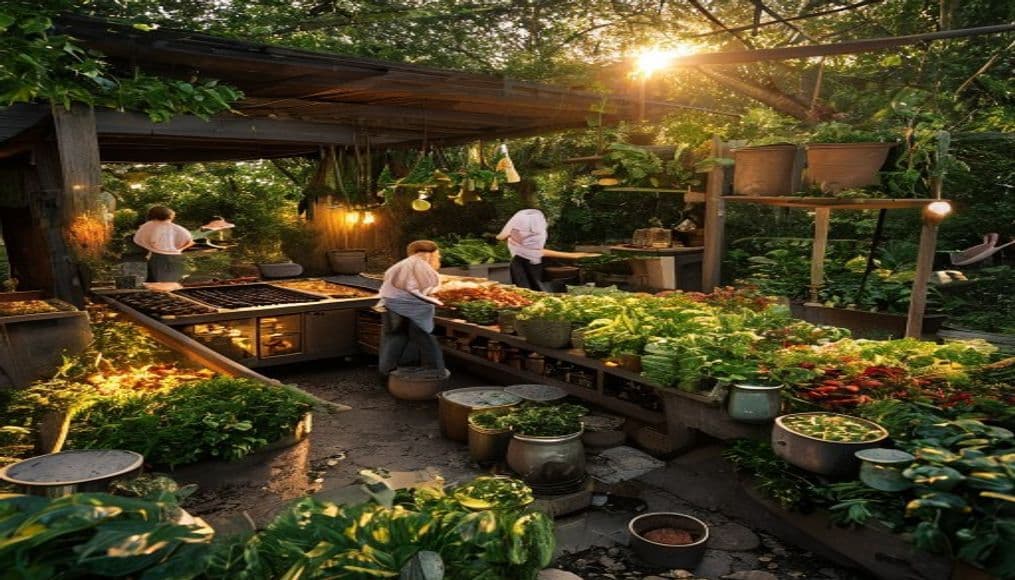
Living ExpressionGarden as pharmacy. Kitchen as laboratory. Meal as ceremony. Food carries frequency.
Garden as pharmacy. Kitchen as laboratory. Meal as ceremony. What you eat is how you listen to the land.
The Feeling
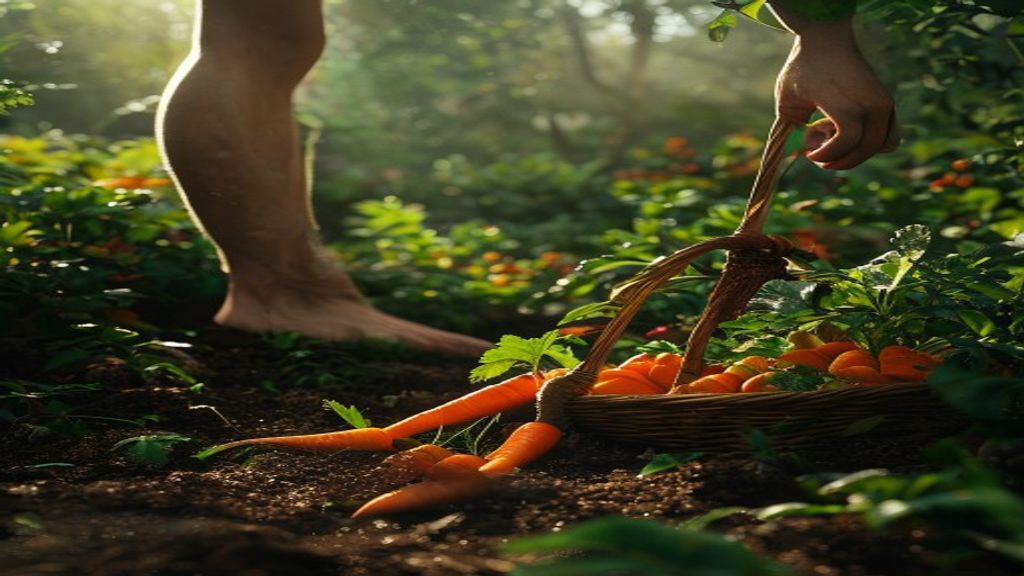
You are standing in the garden at seven in the morning with bare feet on wet soil, pulling carrots. They come out of the earth with a soft resistance, trailing dark soil, smelling like rain and something mineral and alive. You brush one off and bite into it right there, and the sweetness is absurd — nothing from a store has ever tasted like this. Dirt on your lips. Juice on your chin. The carrot was a seed you planted four months ago and now it is becoming you.
In the kitchen, someone is already chopping the herbs you picked yesterday — rosemary, thyme, a handful of lemon balm. The big pot is on the fire. The sourdough that was mixed last night has risen and is ready for the oven. There is no recipe pinned to the wall. The cook is listening to what the garden offered this morning and building something from that conversation. This is what food becomes when it stops being a transaction and starts being a relationship.
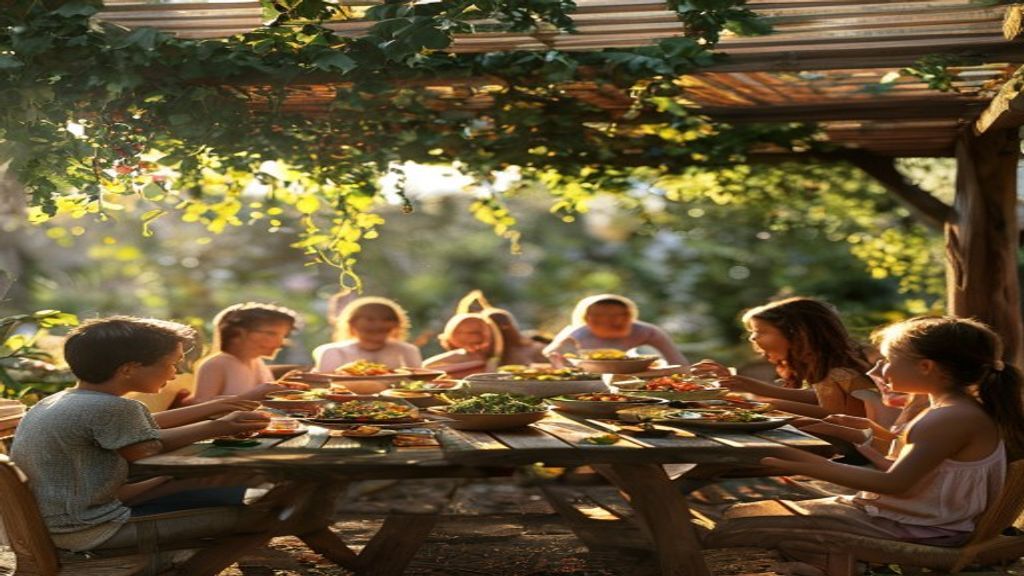
The meal will be eaten together, at the long table, and there will be a moment before anyone picks up a fork — not a prayer exactly, more like a breath — where the whole table recognizes what it took for this food to arrive here. Soil. Rain. Sun. Hands. Time. Microorganisms in the fermentation crock working through the night. The meal is the end of a chain that starts in the stars and passes through the dirt and arrives on your tongue as something you can taste.
How It Lives Here
The seven-layer food forest is the garden's spine — tall canopy trees dropping nitrogen, fruit trees beneath, berry bushes, herbaceous plants, ground cover, root crops, and climbing vines winding through it all. It produces more food per acre than any monoculture and requires almost no maintenance once established. You walk through it and graze — a handful of mulberries here, a snap pea there — and the boundary between garden and kitchen dissolves.
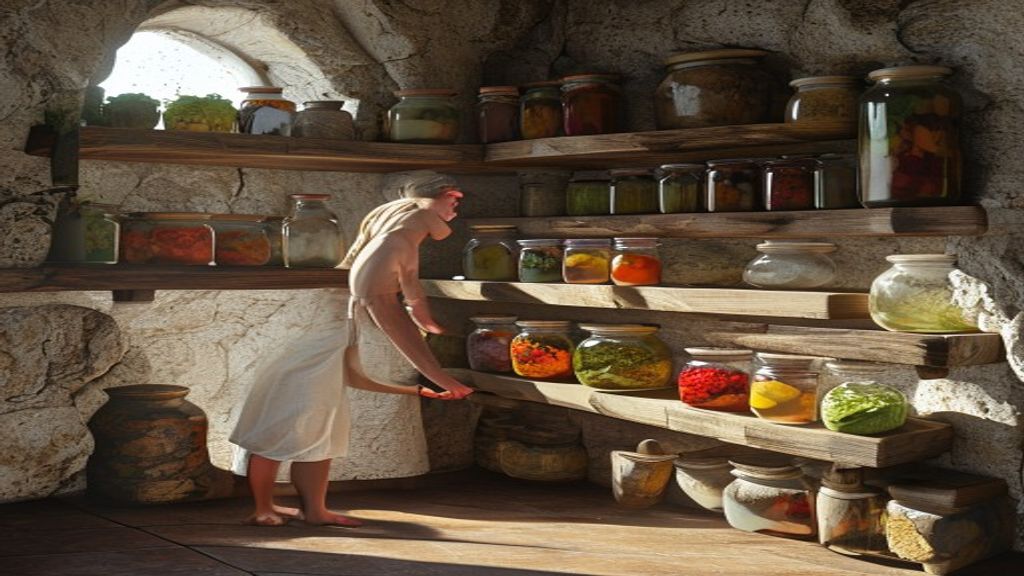
Fermentation runs constantly. Crocks of sauerkraut, kimchi, miso, and kefir line the shelves of the cool room. This is not preservation. It is collaboration with microorganisms — billions of bacteria transforming cabbage into medicine, milk into culture, grain into something the gut recognizes as kin. The children help stir and taste and name the ferments. They understand at five years old that food is alive and wants to keep being alive on its way through you.
Seasonal eating is not a restriction but an attunement. In summer the table overflows with tomatoes and basil and stone fruit. In winter it is roots and stored squashes and fermented things and bone broth simmering all day. The menu follows the land's rhythm, and your body learns to anticipate what is coming. You crave greens in spring because the land is offering greens. You want warmth in autumn because the kitchen is making warmth. The conversation between body and soil becomes fluent.
What Nature Teaches
The Three Sisters planting of Indigenous Americas teaches reciprocity at the root level. Corn grows tall and gives the beans something to climb. Beans fix nitrogen in the soil and feed the corn. Squash spreads its broad leaves across the ground, shading out weeds and holding moisture for all three. No one species dominates. Each one gives what the others need. A meal of corn, beans, and squash is nutritionally complete — the plants taught the people how to eat.
A forest does not plant in rows. It layers, interweaves, lets species find their own relationships. The food forest mimics this. Comfrey mines minerals from deep soil and makes them available when its leaves decompose. Marigolds repel pests. Clover feeds the soil between the fruit trees. The garden is a community, and like any community, its health depends on diversity and interdependence.
Biodynamic farming treats the entire farm as a single organism — soil, plants, animals, humans, moon, stars. Planting by lunar cycles sounds mystical until you learn that root growth responds to gravitational pull and leaf growth responds to light cycles. The old farmers knew this. The soil knows this. We are relearning what was never forgotten by the land.
And at the smallest scale, fermentation teaches that collaboration is the oldest strategy on the planet. The microorganisms that turn milk into yogurt are not following instructions. They are doing what they have done for billions of years — transforming their environment, feeding the next generation, creating complexity from simplicity. We call it cooking. They call it living.
Where You Can See It
At Zaytuna Farm in New South Wales, Geoff Lawton has built sixty-six acres of food forest on land that was degraded cattle pasture. It now produces more food than the cattle ever did, with no irrigation, no fertilizer, and increasing biodiversity every year. Walk through it and you cannot tell where the "farm" ends and the "forest" begins. That is the point.
Visit Sandor Katz at his home in rural Tennessee, where fermentation is a daily practice and the kitchen smells like cultures doing their ancient collaborative work. His books have sparked a worldwide revival of home fermentation — people remembering that food wants to be alive.
In the Japanese satoyama — mountain-edge landscapes managed by villages for centuries — human cultivation increased biodiversity rather than reducing it. Rice paddies, coppiced woodlands, kitchen gardens, and wild-gathered herbs wove together into a food system that was also an ecosystem. The satoyama proves that growing food and growing wilderness can be the same act.
What We're Building
The herb spiral near the kitchen door holds forty varieties of medicinal and culinary plants in a space the size of a parking spot. The cook walks ten steps to pick what the meal needs. The healer walks ten steps to pick what the tea needs. The spiral is where kitchen and pharmacy overlap, and children learn both at once.
Communal cooking happens in groups of at least two, ideally four or more. Not because one person cannot cook for forty — but because cooking alone misses the point. The kitchen is where stories get told, where grief gets stirred into soup, where someone teaches a teenager to make bread and hands them something that will feed them for the rest of their life. No processed food enters the kitchen. Not as a rule — as a natural consequence of having so much real food that the packaged version stops making sense.
The compost cycle closes the loop visibly. Scraps from dinner preparation go into the bin by the kitchen door. Six months later, that bin's contents are spread around the fruit trees. The children who helped cook last winter's soup will pick the peaches that their scraps fed. The chain is not linear — it is a wheel, and every turn makes the soil deeper and the food more alive.
Resources
- One Community - Transition Kitchen — open-source community kitchen design (type: blueprint)
- Wild Fermentation by Sandor Katz — comprehensive fermentation guide and community (type: book)
- Andrew Millison - Permaculture — free open textbook on food forest design (type: book)
- Permaculture Research Institute — food forest case studies and guides (type: community)
- ATTRA Sustainable Agriculture — 300+ free publications on organic food production (type: guide)
The Questions That Live Here
- How do we feed two hundred people primarily from the land without anyone burning out?
- What happens when dietary needs genuinely differ — how does the kitchen hold that without fracturing?
- How do we make food preservation — fermentation, drying, canning — feel like celebration rather than labor?
- When does a child's relationship with food become their first understanding of the living world?
Influences and connections
Listening for voices…
Connected Frequencies
The people, places, works, and concepts the graph shows connected to this one.