Language
Attuned Spaces — What Existing Places Become When They Remember
Living ExpressionThe spaces are already here. The frequency is what arrives. What was built from separation finds its way back into coherence when the people inside it start breathing together.
The spaces are already here. The frequency is what arrives. What was built from separation finds its way back into coherence when the people inside it start breathing together.
The Feeling
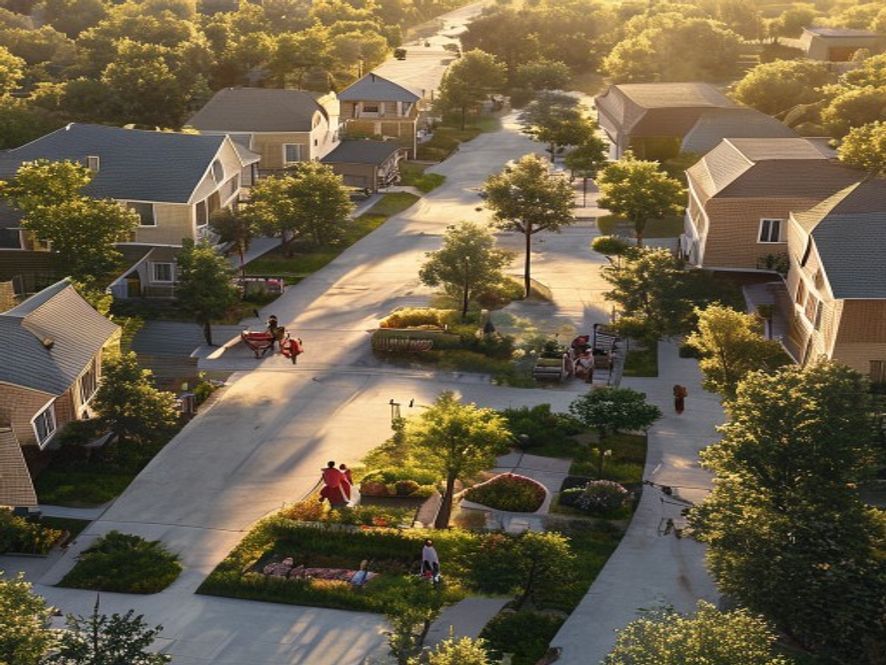
The same suburb you drove through yesterday — the one with identical lawns, garage doors closed, children inside on screens — is physically unchanged when you walk it in the evening a year later. Same asphalt. Same houses. Same distance between front doors. But something has shifted that you feel before you can name it.
Someone planted a shared garden spine where ornamental grass used to be. Not formally, not with master planning and a capital campaign. A few households stood on the sidewalk one Sunday, carried out benches and compost and fruit trees, and left the edges open enough that a child could wander from one porch to the next without passing through a border ritual. A month later there is a long table under a light canopy. Then a shaded workbench. Then a common pantry shelf inside the garage no one was really using. Six months in, seven homes on the cul-de-sac are reading as one continuous social space with many sleeping rooms attached. The driveways are slower. The porches are inhabited. The whole lane feels like it remembers how to be a commons.
The suburb doesn't look like a commune. Nobody moved. Nobody sold. The survey lines may still exist in paperwork, but the field has reorganized around presence. You smell bread at six in the morning because someone's been baking for everyone since they realized bread is better when it's shared the day it's made. You hear a drum on Thursday evenings because someone brought it outside one night and three neighbors joined and now it's just a thing that happens. A few households are quieter than the rest and that is fine; the field can hold different rhythms without hardening them into separation. What was once optimized for privacy is becoming a choreography of many intimacies breathing together.
What Happens at Each Scale
The apartment. Four hundred square feet on the third floor of a twelve-story building in a city. When it wakes up, the feeling is density without pressure. The person who lives here has cleared everything that doesn't carry life and now the room holds only what breathes — a cushion on the floor where they sit with the morning, a low table where they eat and work and write, a bookshelf with only the books they read again, a plant from the courtyard downstairs in an earthen pot, a window cracked open to let the city in as sound. There is space on the floor because the floor is a surface for being. Friends come and sit here and the room is not cramped — the room is quiet enough to hold presence. The apartment has become a cell: small, bounded, coherent, and completely connected to the other cells in the building through the new stairwell mural, through the compost in the basement that everyone contributes to, through the shared pantry on the ground floor where the surplus from the rooftop garden lands and anyone can take what they need.
The apartment building. Twelve stories becomes a vertical village when the stairs become more than stairs. A herb garden climbs the south-facing window wells. The rooftop is a gathering ground — a fire pit under code-compliant safety cover, a sauna someone built in consultation with the structural engineer, benches around the edges with views of the skyline. The laundry room is a workshop — machines still there, but the space beside them has a repair station, a tool library, a bulletin board where people offer things. The lobby has a tea station nobody charges for. The boiler room turns out to have been perfect for the maker space all along. Everyone still has their own door that locks. And everyone has everywhere else too. The building does not feel bigger than it did before. It feels inhabited.
The suburb. What happens when fifteen houses on a cul-de-sac find each other (the story above). What happens when the church in the middle of the neighborhood — underused on weekdays — becomes the place where the home-schooled kids meet, where the elders' circle gathers on Tuesday evenings, where the traveling musicians play when they pass through. The school parking lot — empty on weekends — becomes the farmers' market in summer and the winter solstice fire in December. The strip mall with three vacant storefronts hosts a maker space, a community kitchen, a clinic where the naturopath and the nurse practitioner share a front desk. None of the buildings needed to change. The frequency shifted and the use followed.
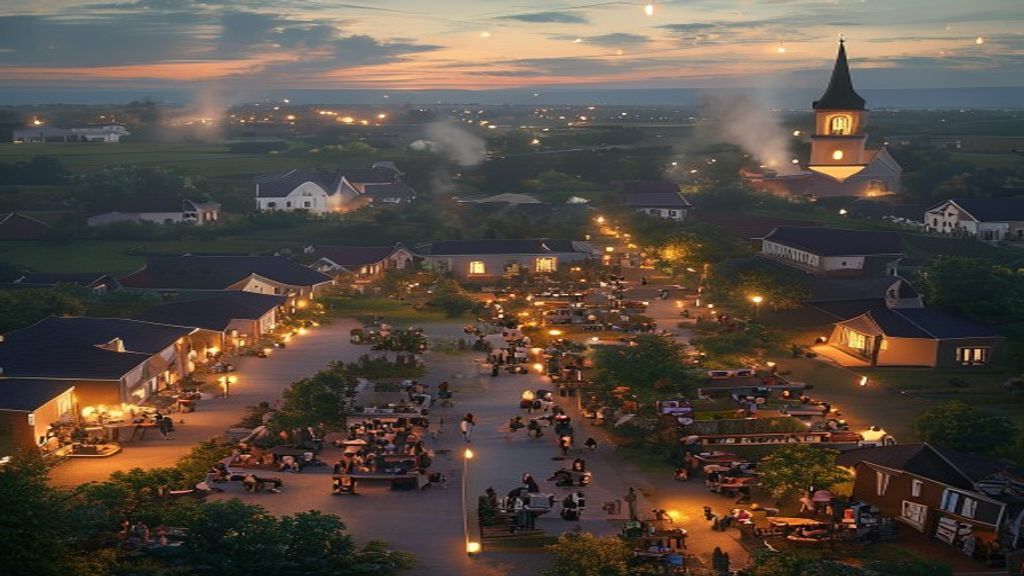
The town. Four thousand people. The town hall still runs. The school still teaches. The grocery store still sells groceries. But the town has also remembered that it is a single organism. There is a town oven — a wood-fired communal kitchen where anyone can bake, with a posted schedule and a rule that surplus bread goes to whoever needs it. There is a town fire — a stone circle in the park where the solstices are marked and the dead are honored. There is a town hold — a weekly silence in the library where anyone can come sit for ninety minutes with no agenda. The town doesn't have a chief or a council any more than a forest has a chief, but it has elders — the people others naturally go to — and the elders meet informally over coffee on Friday mornings and the town tends itself.
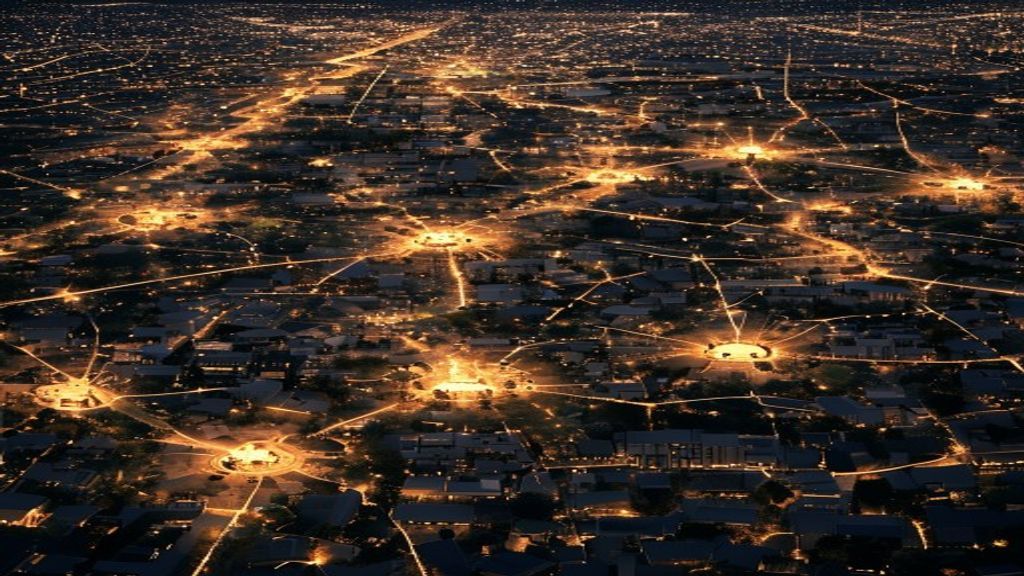
The city. A million people cannot all know each other. But the city is made of neighborhoods, and each neighborhood is a village of 2000-5000 people, and each village is made of blocks, and each block is a cluster of 50-200 people, and each cluster is made of households, and each household is a small circle. The city's coherence lives in the nested scales. The big civic institutions — the opera, the transit system, the water authority — still function, and they function better because the people working in them are coming from neighborhoods that hold them, not from isolation that burns them out. The city's main square holds 50,000 people for the summer solstice fire. The subway carries the same million people, but now there is subtle signage that maps not just the train lines but the practice hubs, the community kitchens, the open maker spaces. The city is what it always was — an incredible density of human possibility — without the loneliness that density used to mean.
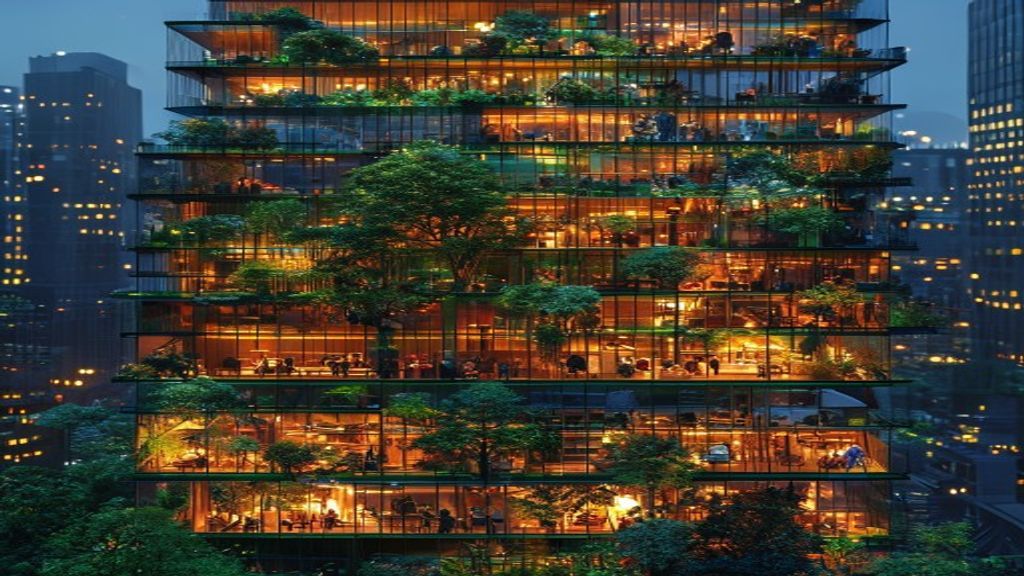
The skyscraper. Eighty floors of office space that used to empty at 6 PM and refill at 9 AM with the same people treating each other as functions. Now: floors 1-3 are the public layer — a lobby that is also a café that is also a library that is also a place you can just sit. Floors 40 and 80 are the community layers — gyms, gardens, practice rooms, rooftop fires. The offices in between still work, but the rhythm is different. The morning begins with a twenty-minute silence that anyone can join on floor 40. Lunch is eaten together when people want to. The 5 PM transition isn't a sudden flood through the lobby — it's a slow breath as people sit with what they did, release it, and move into their next layer of life. The building sensors — originally installed for HVAC optimization — now also measure the pulse of occupation, the rhythm of gathering, the coherence of the whole building treating itself as one body.
Resting, Harmonizing, Gathering
Resting. Every attuned space has somewhere to lay down. Not a scheduled rest room. A surface where a body can release — a floor cushion in the apartment, a hammock in the building's stairwell landing, a grove of trees in the suburb's shared yard, a bench in the town square that is shaped for reclining, a meditation floor in the skyscraper's 40th level. Rest is treated as one of the space's primary intelligences. People nap in public and nobody checks their phone for it. The rhythm of the day includes a trough — 1 PM to 4 PM — when the village intensity drops and if you listen you can hear the collective breath slow. After the trough, the afternoon gathers itself again and the evening arrives.
Harmonizing. When the field shifts — a disagreement, a new arrival, a death, a season change — there is practice. Not emergency theater. Practice. Someone starts humming and others find the note. The Thursday drum circle changes key for the week that carries the grief. The town fire happens twice that week instead of once. The apartment building's elevator plays the same piece of music every morning for a month while something is re-tuning. Harmonizing isn't conflict resolution — it's the field finding its pitch again, and everyone in it contributing a voice.
Gathering. Small gatherings happen constantly and without announcement — three people on a stoop with tea. Medium gatherings happen rhythmically — Thursday drum, Sunday long table, full moon walk, Tuesday elder circle. Large gatherings mark the seasons — solstices, equinoxes, the planting, the harvest, the first snow. The scale of the space determines the scale of the gathering it can hold, and the population inside the space is what decides when a gathering wants to form. Gathering is never scheduled into submission. A gathering that doesn't want to happen doesn't.
Storytelling. There are places in every attuned space where story lives. The hearth interior in the village commons. The bookshelf in the apartment building's lobby. The bench under the oak tree in the park. The 40th-floor lounge in the skyscraper. The child asks their question and is not redirected to Google — they are sent to the elder at the bench who saw the thing happen. The newcomer tells their arrival story to whoever is there that evening and is folded in. The grief is spoken, and the room holds it, and the next story unfolds from there. Story is how the organism metabolizes experience into wisdom. Every space has a hearth.
Moving together. Dawn movement on the rooftop. Contact improv in the community room. The walk around the block that becomes a weekly ritual. The dance floor that opens Saturday night in the town hall. The skyscraper's floor-40 yoga class at 7 AM and 5 PM. Movement together is how the field reminds its cells that they are not separate bodies. Two bodies dancing feel the field. A hundred bodies dancing are the field. A city of a million people, every one of whom has a practice of moving with others at least once a week, vibrates at a frequency that is felt by every city that borders it.
Ritual and ceremony. The small rituals are daily — the morning silence, the blessing before the meal, the lighting of the evening candle, the placing of flowers at the doorway. The larger ceremonies are seasonal — the solstice fire, the harvest feast, the naming of a child, the honoring of a death, the welcome of a newcomer. The rituals don't require a priest. They require presence. Anyone in the community can hold the space. The form matters less than the frequency the form produces. A ritual that no longer produces the frequency dissolves. A new ritual emerges when the field calls for one. The attuned space knows it is a ritual space, not because of the symbols in it, but because the people inside it know how to bring presence into any moment, and the space responds.
How the Shape Finds Itself
No one designs this. No one draws a master plan and implements it. The shape finds itself the way water finds its level — by every cell asking what would make me more alive right now and acting on the truthful answer.
Sometimes the answer is: open a path between two porches. Sometimes the answer is: offer the garage as a workshop. Sometimes the answer is: light a fire on Thursday evening and see who comes. Sometimes the answer is: sit in silence for twenty minutes before you open your laptop.
The attuned space emerges from the accumulation of these small truthful answers. It cannot be rushed. It cannot be imposed. It can only be invited — by one person, then two, then seven, then the whole cul-de-sac, then the whole town. And the moment it takes, it takes fast. What looked impossible for a decade becomes ordinary in a year. What was a suburb becomes a village. What was a skyscraper becomes a vertical forest. What was a city becomes a constellation of villages. What was the world as we've known it becomes the world as it remembers how to be.
The Questions That Live Here
These are not planning questions. They are listening questions:
- Which shell around us is already asking to be retuned rather than replaced?
- What kind of gathering is this place quietly ready to hold now?
- Where is privacy still nourishing, and where is separation only leftover habit?
- What becomes possible when a building is named by its quality of presence rather than by its commercial function?
Influences and connections
Listening for voices…
Connected Frequencies
The people, places, works, and concepts the graph shows connected to this one.