Language
The Network
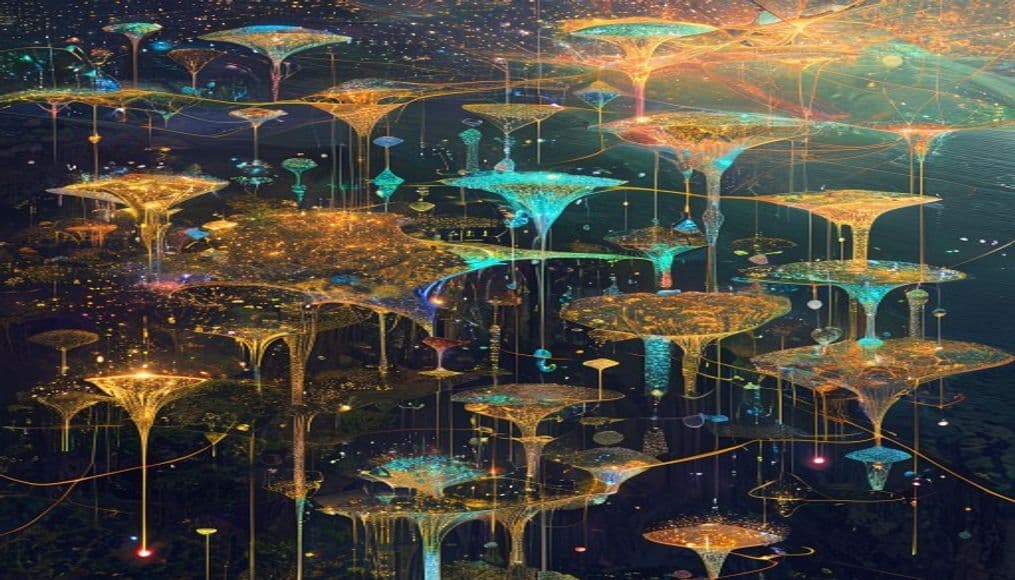
Living ExpressionField within field of fields. Mycorrhizal. Forest not competing trees — cooperative network. Coherence Network IS this at planetary scale.
The mycorrhizal web between communities. No community is sovereign in isolation. Seeds, knowledge, people, surplus, medicine, celebration flowing between nodes. What you cannot grow, someone can. What you overflow with, someone needs.
The Feeling
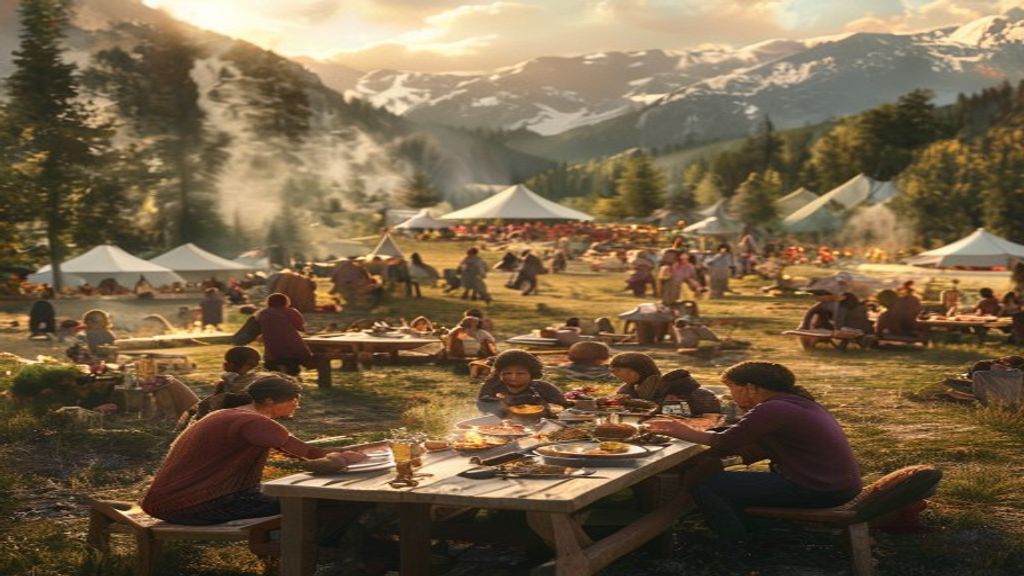
I am standing at the edge of a gathering where three communities have converged. The hosts are from a valley in Portugal. The visitors arrived yesterday from a forest village in Germany and a coastal collective in Costa Rica. Nobody is presenting. Nobody is networking. People are cooking together, comparing fermentation techniques, arguing gently about water catchment designs, teaching each other songs in three languages.
A woman from the German village is showing our builder a timber joint she learned from a Japanese carpenter who visited her community last spring. The knowledge traveled: Japan to Germany to Portugal, carried in hands and memory, not in a document. A child from Costa Rica is playing with children who don't share a single word of common language. They don't need one. They have sticks, mud, and the universal grammar of play.
I feel something in my chest that I can only describe as belonging to something larger. Not an organization. Not a movement. A living network -- the way roots belong to a forest.
Why Network
No community is an island. Even the most self-sufficient settlement cannot produce everything it needs. The land will not grow every medicine. The soil will not yield every mineral. The people, however gifted, will not carry every skill. A community that tries to do everything alone will exhaust itself the way a single tree in a field exhausts itself -- all crown and no root web, every drought faced alone, every storm absorbed by one trunk.
The mycorrhizal forest runs on the opposite principle. A Douglas fir cannot produce phosphorus. The mycorrhizal fungi can unlock it from rock. The fungi cannot photosynthesize. So they trade -- carbon for phosphorus, sugar for mineral -- not through negotiation but through gradient. The network is not an addition to the forest. The network IS the forest. Human communities have always known this. Polynesian navigators connected islands across four thousand miles of open ocean. The Silk Road was a mycelial web carrying spices, mathematics, medicine, and astronomy between civilizations that could not have produced them alone.
The question is not whether to network. The question is how to network without re-creating the dependency patterns of the old world -- without becoming a supply chain, a franchise, a hierarchy of core and periphery. The answer is in the forest: lateral connection, no central node, surplus flowing by gradient, every node sovereign and every node connected.
How It Lives Here
Three times a year, two or three members travel to a sister community. They stay for two weeks, work alongside their hosts, eat their food, learn their rhythms. When they return, they carry something back -- a seed variety, a governance practice, a song, a way of processing grief that works better than ours. The exchange is not transactional. It is mycorrhizal. What flows between communities is what each one needs, not what was negotiated.
The digital layer is simple: a shared sensing dashboard where each community posts a monthly pulse. Not reports. Pulses. "We are grieving a departure." "Our water system failed and we rebuilt it -- here is what we learned." "We have surplus tomato seeds and a carpenter with free weeks in October." The network responds through resonance.
Once a year, the whole network gathers. The location rotates. The gathering is not a conference. It is a festival of mutual recognition -- proof that this way of living is not isolated, not fragile, not an experiment. It is a forest.
What Nature Teaches
A forest is not a collection of competing trees. It is a cooperative network connected by mycorrhizal fungi -- the Wood Wide Web. Through underground threads, a mother tree sends carbon to a shaded seedling. A dying tree dumps its nutrients into the network. Trees under insect attack send chemical warnings through the mycelium, and distant trees begin producing defensive compounds before the insects arrive.
No tree manages the network. No tree designed it. It emerged from the simple principle that connection benefits every node. The network IS the intelligence. The internet was built on the same pattern -- distributed, no central node, resilient because the network is the structure. But the internet was captured by centralization. The lesson: distributed networks must actively resist the gravity of centralization. The mycorrhizal web has no headquarters. The Coherence Network must have none either.
Where You Can See It
Gaviotas, Colombia -- Paolo Lugari gathered engineers, artists, and campesinos on the barren llanos in 1971. They developed water pumps, solar heaters, and reforestation techniques and gave every innovation away. Gaviotas did not franchise. It pollinated. Today their eight-thousand-hectare forest funds the community while technologies they gave away serve hundreds of thousands.
Auroville, India -- three thousand residents from fifty countries. Their Earth Center has trained thousands in compressed earth construction -- knowledge that has traveled to communities across Africa, South America, and Southeast Asia. No franchise. Living connections carrying techniques, seeds, and people across five continents.
GEN (Global Ecovillage Network) -- founded 1995, now connecting over ten thousand communities across five continental networks. GEN does not govern. It convenes. Its Ecovillage Design Education curriculum has been taught in forty-plus countries, adapted to local soil each time.
Transition Towns -- Rob Hopkins started in Totnes in 2005. Within five years, over a thousand initiatives in fifty countries. No central office approved new chapters. The pattern spread because it was useful, adaptable, and freely given.
CASA -- the Latin American arm of GEN, connecting ecovillages, indigenous communities, and urban sustainability projects from Mexico to Patagonia. Demonstrates a network spanning radically different cultures without imposing a single model.
What We're Building
Year one: connection with three to five sister communities within a day's drive. Monthly pulse updates, one exchange visit per season, a bioregional surplus list on a shared wiki, a LoRa mesh linking the nearest communities for communication independent of the internet. Year two: the first bioregional gathering on our land and one shared physical project. Year three: the triangle becomes a pentagon, traveling members become regular, the digital infrastructure is robust -- community-owned servers, encrypted messaging, a living knowledge commons that no corporation can touch. By year five, the network is self-sustaining. Surplus flows by gradient. New communities are welcomed the way a forest welcomes a seedling.
Practical guide: How to actually do this
Resources
- Global Ecovillage Network -- 10,000+ communities, 5 continental networks (type: community)
- Foundation for Intentional Community -- most comprehensive directory (type: community)
- Transition Network -- 1,000+ resilience initiatives in 50 countries (type: community)
- Meshtastic -- open-source LoRa mesh firmware (type: tool)
- Matrix.org -- open-source encrypted federated messaging (type: tool)
- Open Source Ecology -- 50 open-source machines for self-sufficiency (type: tool)
The Questions That Live Here
- What is the minimum number of nodes before a network becomes self-sustaining?
- How do communities share resources without creating dependency?
- How do you maintain coherence across distance when the whole point is embodied presence?
- How do you resist the gravity of centralization?
- When does a network become too large to feel like a web and start feeling like an institution?
Influences and connections
Listening for voices…
Connected Frequencies
The people, places, works, and concepts the graph shows connected to this one.
Concepts · 18
Attuned Spaces — What Existing Places Become When They Rememberresonates withCirculationresonates withEdges as Vitality — Why Content Without Connection Becomes Sedimentresonates withFederation as Freedom — Sovereign Cells Recognizing Each Other Without a Centerresonates withFieldresonates withField Edgeresonates with