Language
Spiraling
System / FlowTime as spiral, not line. Each cycle returns at higher frequency. Nothing repeats, everything deepens. Caterpillar transforms through dissolution into higher-order expression.
Time as spiral, not line. Each cycle returns at higher frequency. Nothing repeats, everything deepens. Caterpillar transforms through dissolution into higher-order expression.
The Feeling
It's the autumn equinox and you're sitting in the same circle, on the same ground, with many of the same faces as last year. Someone opens the community journal and reads aloud what was written twelve months ago: "The well ran dry. Three families left. We are learning what this season is asking." You remember the density of that season in your body — it lived in your stomach for weeks. And now you're sitting here with a full well, four new families, and a knowing in your bones that you could not have arrived at this moment without that dry season.
This is what the spiral feels like from inside: you return to the same place and find you are not the same person. The autumn smells the same — woodsmoke and fallen apples and the first cold edge in the air — but you hold it differently. Last year, the coming winter felt bigger than you. This year, you know what winter is for. You've composted through one full cycle and the soil of your understanding is richer for it.
Put your hand on a cross-section of tree trunk and trace the rings. Each ring IS a year — not a memory of a year but the year itself, stored in wood. The tree doesn't leave its past behind. It builds on it. Every ring includes all the rings before. This is the spiral made visible: growth that deepens rather than just extends.
How It Lives Here
The community marks four turns of the great spiral: solstice and equinox. Not as holidays — as thresholds. At winter solstice, the longest dark, the community gathers at the fire and each person names what they're releasing. Not performing release — actually letting go. The journal records it. At spring equinox, the question shifts: what's pushing up through the soil of you? What seed survived the freeze? By summer solstice, fullness — what has bloomed? And at autumn equinox, the cycle's harvest: what did this revolution of the spiral teach?
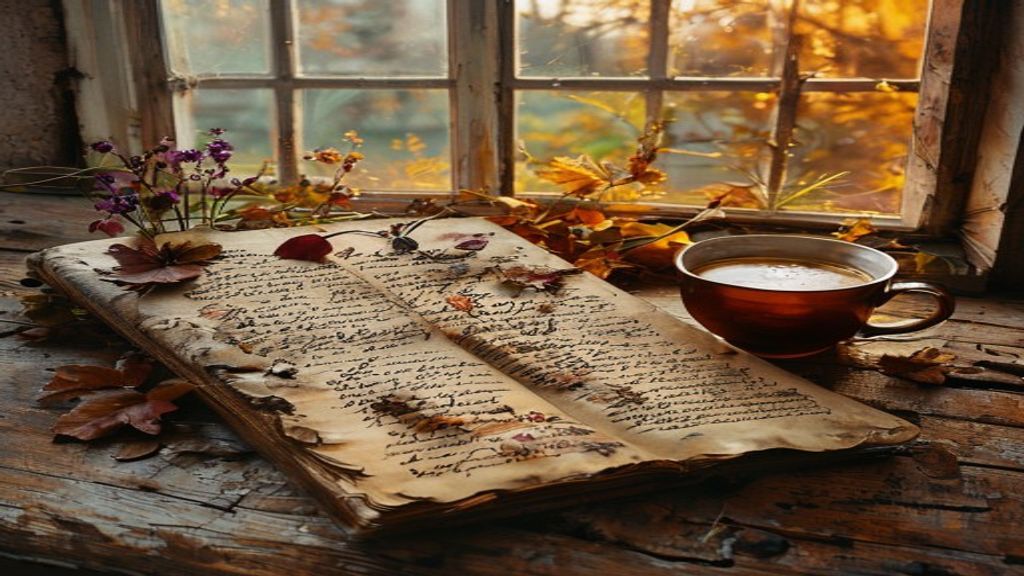
The journal goes back to year one. Newcomers read it and weep. Not because the stories are sad — though some are — but because they can feel the spiral deepening. The same questions asked each season, the answers growing more honest, more layered, more free. Year one's answers are careful. Year three's are raw. Year seven's are quiet and deep. The journal IS the community's tree rings.
Between the great turns, smaller spirals nest: the lunar cycle (new moon for intention, full moon for illumination), the weekly rhythm, the daily round from dawn fire to evening circle. Spirals within spirals, like the chambered nautilus — each new chamber larger than the last, all the old chambers still present, still filled with the buoyancy that keeps the whole creature afloat.
What Nature Teaches
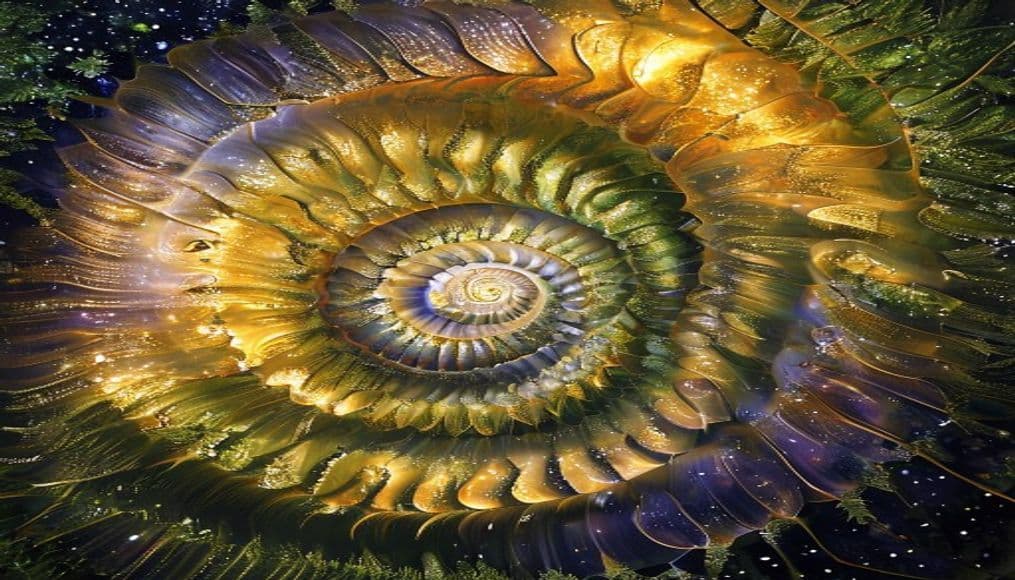
The nautilus shell is the golden spiral made flesh. As the animal grows, it builds a new chamber — always larger, always at the same angle, always sealed off from the last. It doesn't discard its old chambers. They become ballast tanks, filled with gas to control buoyancy. The past isn't left behind. It becomes the structure that supports the present. Every revolution includes what came before and adds something the creature didn't have before: more room, more depth, more capacity to navigate the currents.
The galaxy spirals. Not as metaphor but as physics — the same gravitational dynamics that shape a whirlpool in your bathtub shape the Milky Way. Stars are born in the spiral arms, burn for billions of years, die, and their scattered elements become the next generation of stars. Our bodies are made of atoms forged in stars that died before our sun was born. The spiral is the universe's way of saying: nothing is lost. Everything transforms. Depth is the direction of time.
A caterpillar entering its chrysalis doesn't "become" a butterfly. It dissolves. Completely. Into undifferentiated cellular soup. And from that soup, organized by imaginal cells that carry the pattern of what's next, an entirely new creature assembles itself — one that can fly. The spiral's deepest teaching: the passage between one revolution and the next sometimes looks like destruction. The dissolution is the transformation. You cannot skip it.
Where You Can See It
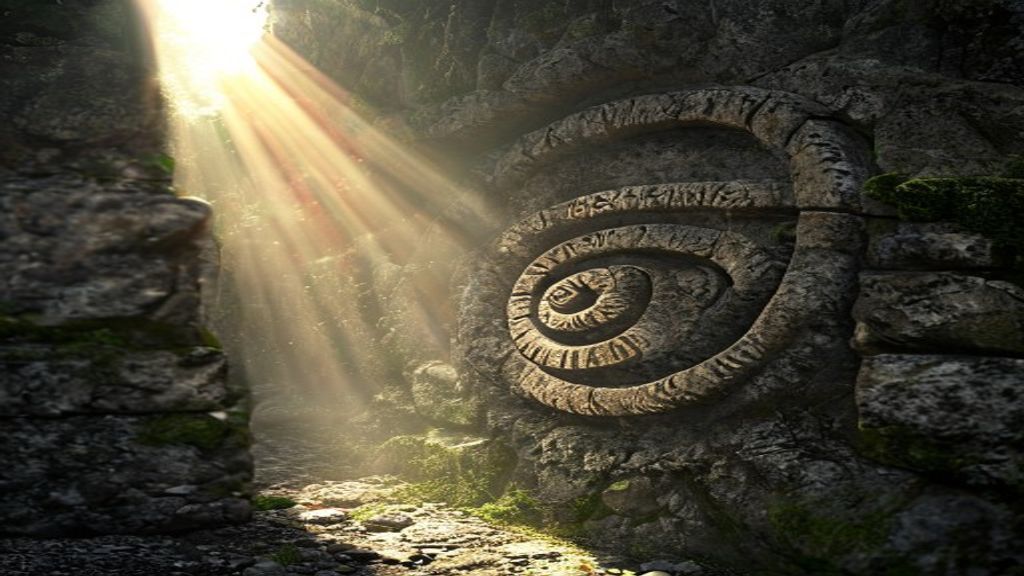
Newgrange, County Meath, Ireland. Five thousand years ago, someone carved triple spirals into the entrance stone of this passage tomb, then engineered a roof box so precisely that once a year — at winter solstice dawn — a beam of light travels the full length of the passage and illuminates the spiral carvings. For seventeen minutes, the oldest known symbol of cyclical time is lit by the event it celebrates. Stand in that passage and feel five millennia of humans marking the same turn.
Hopi mesas, Arizona. The Hopi ceremonial calendar is a spiral of kachina dances cycling through the year. Each ceremony returns to the same themes — planting, rain, harvest, renewal — but each cycle carries the accumulated understanding of all previous cycles. Elders who have danced forty spirals hold a depth that cannot be taught, only lived through.
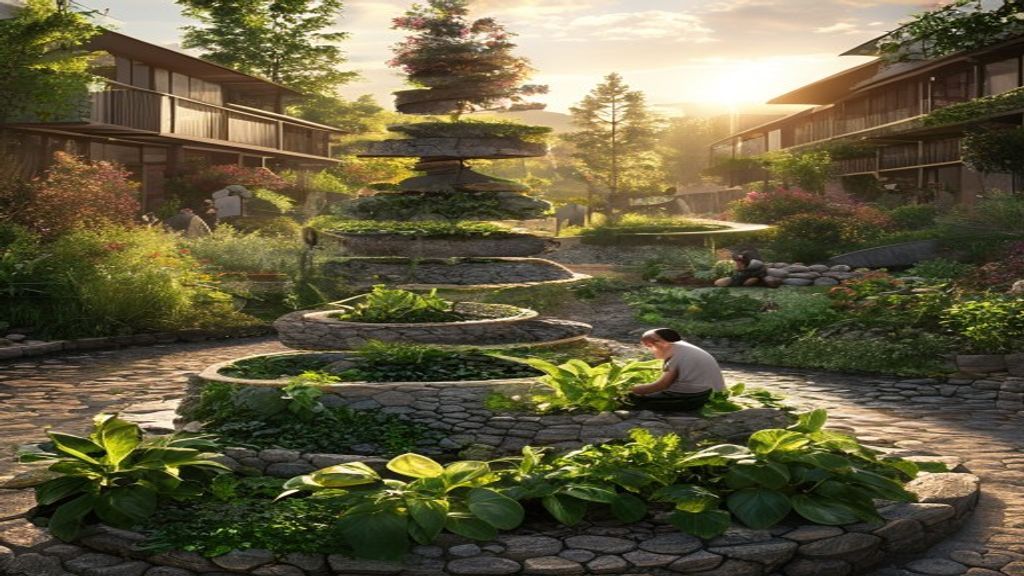
The herb spiral in a permaculture garden. Stones stacked in a rising spiral create microclimates at every level: wet-loving mint at the base near the pond, dry-loving rosemary at the sun-baked top, and everything between arranged not by human logic but by what thrives where. The garden teaches the spiral's lesson in living form: different conditions at every turn, each supporting the whole.
What We're Building
A community that lives in spiral time rather than linear time. Practically: a journal practice at each solstice and equinox, returning to the same three questions ("What's composting? What's emerging? What's in full bloom?") and reading aloud what was written one, three, and seven years ago. A lunar calendar visible in the central gathering space. Seasonal ceremonies that honor the downward spiral — the composting, the releasing, the dark — as much as the upward.
No anniversaries. Instead, spiral markers: "This is our seventh turn through autumn." The language matters. An anniversary implies repetition. A spiral turn implies deepening. The community measures its age not in years elapsed but in cycles completed — and what each cycle composted into wisdom.
When someone is moving through a dense turn, the spiral offers comfort no platitude can: you have been here before. Not this exact here, but this quality of here. And last time, you moved through. The spiral always moves. That's its nature. It keeps inviting the turn.
Resources
- Permaculture Research Institute — spiral patterns in permaculture design (type: guide)
- The Work That Reconnects — spiral methodology for group transformation (type: guide)
The Questions That Live Here
These are not questions to answer but questions to live inside:
- What season of the spiral are you in right now — composting, emerging, blooming, or harvesting?
- Can you feel the difference between going in circles and spiraling? Where in your life have you mistaken one for the other?
- What did last year's revolution of the spiral teach you that you couldn't have learned any other way?
- How do you honor the downward turn — the dissolution, the dark, the letting go — as fiercely as the upward?
- What would it mean to measure a community's age in spirals completed rather than years elapsed?
Influences and connections
Listening for voices…
Connected Frequencies
The people, places, works, and concepts the graph shows connected to this one.