Language
Ceremony
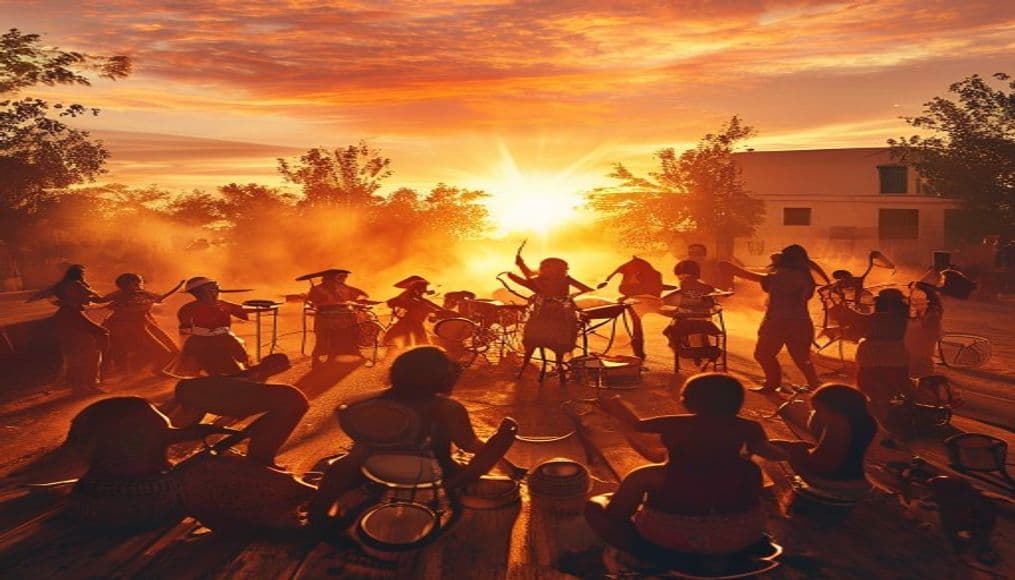
Living ExpressionHonoring what wants honoring. Like elephants circling a dying member. Singing, silence, fire, water, movement, breath. Form follows the moment.
The Feeling
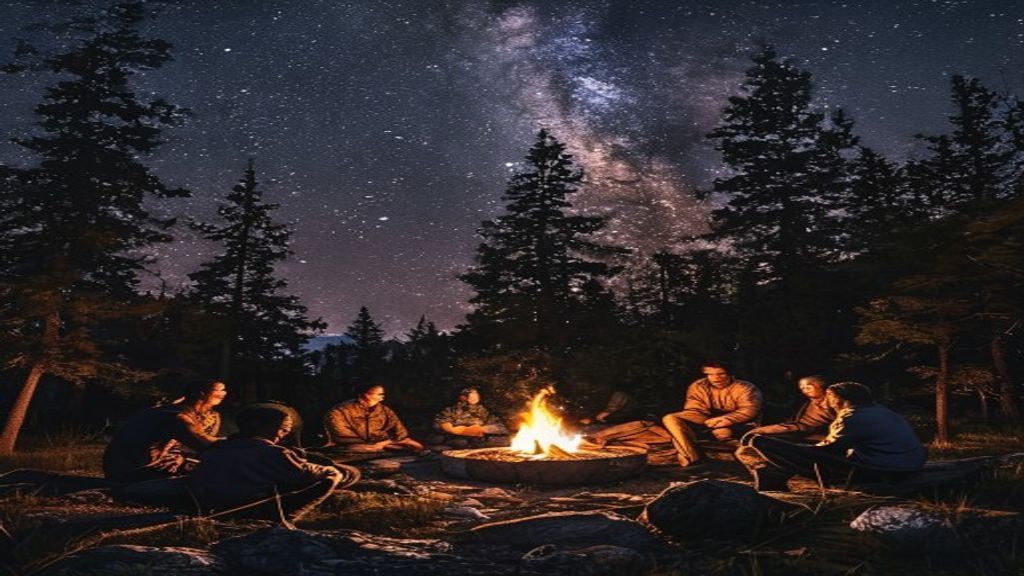
Someone has lit a fire. You did not plan to stop walking, but your feet bring you to the circle anyway. The flames are low, breathing in that slow way fire breathes when it is not in a hurry. There are faces around the edge — some you know, some you are still learning. Nobody speaks for a while. The fire does the talking.
Something in your chest unclenches. There is a heaviness you have been carrying for weeks that suddenly has a place to be. You do not need to name it. You do not need to fix it. The circle holds it the way a bowl holds water — simply, completely, by being the right shape.
Later someone will begin to sing, and others will join, and the sound will be rough and beautiful and entirely unrehearsed. But right now there is just the fire and the faces and the feeling that something is being honored that has no name.
How It Lives Here
Every new moon, the fire is lit. No agenda, no leader, no script. People gather or they do not. Sometimes the circle is four people and a candle. Sometimes it is forty and a bonfire. The form follows whatever the moment is holding — grief, gratitude, the turning of a season, the arrival of a child, the departure of a friend.
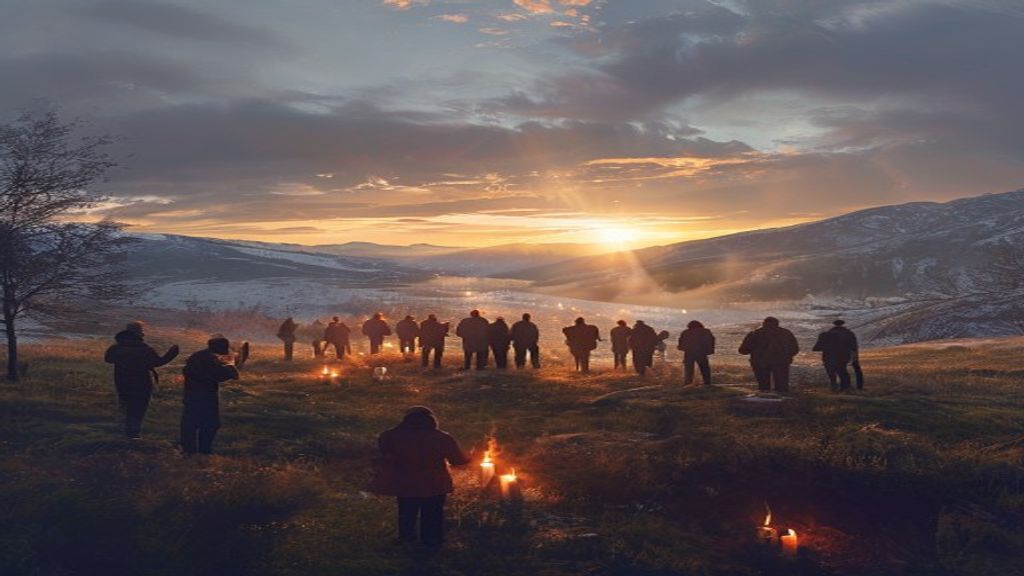
At solstice, the whole community walks to the hilltop before dawn and faces east. In winter, breath hangs visible in the cold air and hands are clasped tight. In summer, bare feet on warm earth and the sky already brightening. The sun comes or it does not come — some years the clouds are thick. It does not matter. The ceremony is the gathering, not the spectacle.
When someone new arrives, the community sings them in. When someone leaves, the community sings them out. There are no prescribed words. The moment teaches the ceremony. A death is held with silence and touch, the way elephants circle a dying member — breathing together, not ritualizing, just being the field's honest response to what is happening.
Between the big ceremonies, smaller ones happen without anyone naming them. A meal where someone sets wildflowers on the table and everyone pauses before eating. A walk to the river after a hard week, three people standing in the current without speaking. A child's first harvest from her own garden plot, held up for the kitchen to see. The field is always offering moments worth honoring. Ceremony is the practice of noticing them.
What Nature Teaches
An elephant herd encountering the bones of a dead relative will stop, circle, touch the bones with their trunks, and stand in silence. They will return to that spot years later. No one taught them this. The response lives in the body, in the field between bodies.
Fire is the oldest gathering technology. Long before language was complex enough for philosophy, humans sat around flames and something happened between them — a synchronization of breath and heartbeat, a dropping of individual vigilance, a shared entering into something larger. Every culture on Earth independently developed fire ceremony. The convergence is not coincidence. It is recognition.
The Balinese weave ceremony into every hour. Canang sari — small offerings of flowers and rice — appear on doorsteps, dashboards, sidewalk cracks. Ceremony is not separate from living. It is the texture of attention that says: I notice this. This matters. This moment is not disposable.
The Japanese tea ceremony distills an entire philosophy into one cup. Every movement intentional. The water poured just so. The bowl turned to show its best face to the guest. Not because the movements are sacred — because attention itself is sacred. An hour of ordinary actions performed with full presence becomes extraordinary. The ceremony teaches: any moment you fully inhabit becomes a ceremony.
Where You Can See It
In Oaxaca during Dia de los Muertos, the boundary between the living and the dead dissolves for a night. Marigold petals carpet the streets. Altars overflow with photographs and favorite foods of those who have gone. Children run laughing through cemeteries. There is no contradiction between grief and joy — the ceremony holds both.
At Taize in France, a hundred thousand visitors a year sit in a small stone church and sing the same simple phrases over and over until the repetition becomes a kind of silence. Catholic, Protestant, atheist — it does not matter. The chant is below doctrine. It reaches the frequency where labels dissolve.
In the underground Temples of Humankind at Damanhur, forty years of sacred art cover every surface — mosaics, stained glass, paintings of breathtaking detail, all carved into a hillside by community members. The temples are not religious. They are what happens when a community decides that beauty is its foundation, not its decoration.
What We're Building
A fire circle at every new moon. Seasonal ceremonies at solstice and equinox — not reenactments of traditions that are not ours, but honest responses to what the turning of the year asks of us. Arrival ceremonies and departure ceremonies. The permission for grief to be public. The practice of gratitude as a shared act, not a private journaling exercise.
No prescribed forms. A willingness to stand in silence when silence is what the moment needs. A willingness to sing when singing is what the moment needs. A fire that is always ready to be lit, because you never know when the moment will arrive that needs one.
The only liturgy: pay attention to what wants honoring, and honor it. The invitation is simple: do not walk past the moments that are asking to be held.
Tending the Fire Circle
A fire circle needs almost nothing and teaches almost everything. Here is what the communities who do this well have learned.
The space. A circle of earth, cleared of grass, twelve to twenty feet across. Logs or stones for sitting, arranged so every person can see every other face. No chairs with backs -- the body stays alert when it holds itself. The fire pit is low, just a shallow bowl in the ground lined with river stone. Keep a pile of dry kindling and split hardwood nearby so the fire never needs to wait for fuel.
Tending the flame. One person tends the fire, not as leader but as listener. They feed it when it asks, let it settle when it wants to breathe. The fire tender watches faces as much as flame -- when the circle needs warmth, they build it up; when words are moving through the group, they let it soften to embers. Children can tend fire from about age eight with an elder nearby. The tending itself is the first teaching.
No agenda, no clock. The fire starts when someone lights it. People arrive when they feel the pull. The circle opens with silence -- long enough for the day to fall away, usually five to ten minutes. If words come, they come. If song comes, it comes. The ending arrives the way dawn arrives: everyone knows, and someone says "the fire is ready to sleep."
Seasonal Ceremonies
The turning of the year asks different things from the community, and the ceremonies follow what is asked.
Winter solstice. The longest night. The community gathers before dawn on the hilltop and waits for whatever light the sky offers. In cold climates, a bonfire burns all night and people keep vigil in shifts, feeding the flame through the dark hours. At dawn, whether the sun is visible or hidden, someone speaks what they are carrying into the new light. Hot broth is passed hand to hand.
Spring equinox. The soil is warming. The ceremony happens in the garden -- seeds are blessed, not by any doctrine, but by being held in the hands of every person who will tend them. Each person plants one thing and names what they hope will grow in their own life alongside it.
Summer solstice. The longest day. A feast that starts at noon and does not end until the stars appear. Every household brings what they grew or made. Music happens without being organized. The children stay up late and no one minds.
Autumn equinox. The composting ceremony. What has completed its cycle is named, thanked, and released. Dried flowers and written intentions go into the fire. The harvest is shared. Someone always cries, and the crying is welcome.
When Life Turns
Arrivals, departures, births, deaths -- these are the ceremonies the moment itself teaches.
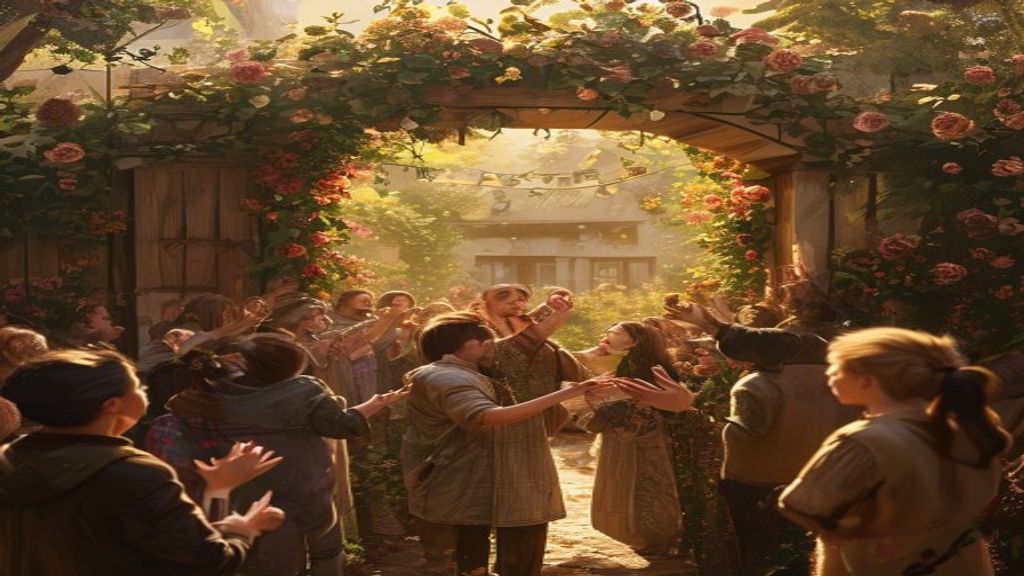
Welcoming. When someone new arrives, the community gathers at the threshold and sings them across. The song does not need to be good. It needs to be real. Someone places bread and salt in the newcomer's hands -- the oldest welcome there is.
Departure. When someone leaves, the same gathering at the threshold. But now the community sings them out, and each person who wants to speaks one thing they received from the one who is going. The departing person carries those words.
Death. The body stays in the community for at least a day. People sit with it in shifts, the way elephants circle their dead -- not ritualizing, just being present. When the body goes to the earth, the community walks together to the place and stands in silence until the silence says it is done.
Resources
- The Work That Reconnects — Joanna Macy — free facilitation guides for group ceremonies of gratitude and grief (type: guide)
- Damanhur — Italian ecovillage with underground Temples of Humankind (type: community)
- Taize Community — ecumenical community in France, simple repetitive chanting (type: community)
- Agnihotra — Daily Fire Ceremony — Vedic fire practice at sunrise/sunset, humanity's oldest bonding technology (type: community)
The Questions That Live Here
- How does ceremony emerge when no one is in charge of it?
- What is the minimum a community needs to honor — arrival, departure, solstice, death?
- How do you create ceremonies that resonate across people with completely different spiritual backgrounds?
- When does a spontaneous moment of honoring become a tradition, and when should traditions be allowed to die?
- How do you teach children that ceremony is not performance — that the audience is the moment itself?
Influences and connections
Listening for voices…
Connected Frequencies
The people, places, works, and concepts the graph shows connected to this one.