Language
Play
Living ExpressionThe field's primary frequency. How it learns, creates, heals, bonds. Dolphins invest enormous energy in play — social intelligence. Most quantum state: superposition.
The Feeling
You arrive at the field's edge and hear it before you see it — a sound that has no single source. Laughter layered over hammering, a splash, someone singing off-key on purpose. Your body responds before your mind catches up. Something loosens in your chest. Your stride changes. You're walking faster without deciding to.
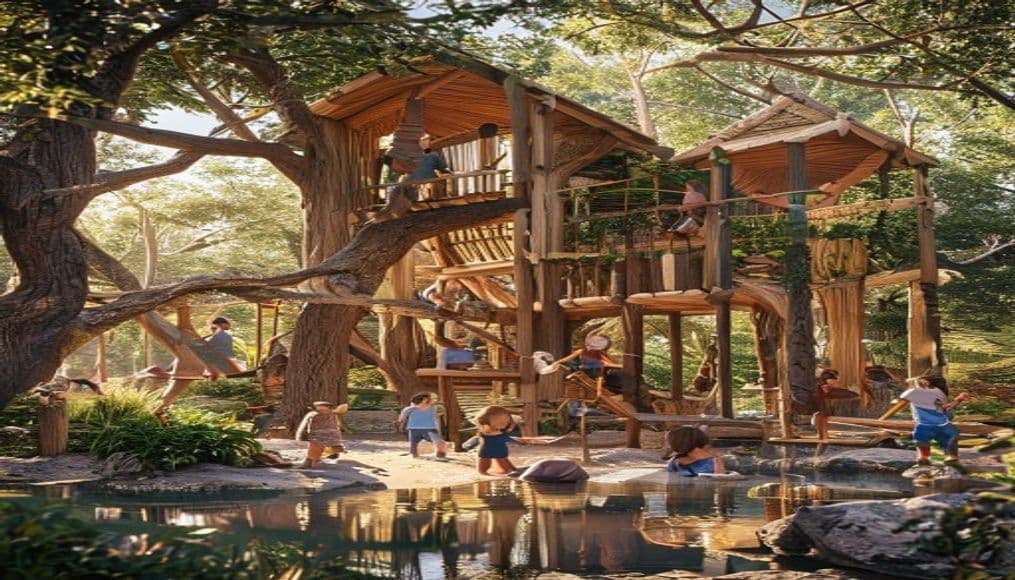
A woman in her sixties is balancing on a rope strung between two trees, arms wide, grinning like she just discovered gravity. Three kids are building something impossible out of pallets and rope — a watchtower, a spaceship, a house for a dragon. Nobody asked them to. Nobody is watching with a clipboard. A man sits on an overturned bucket, whittling a stick into something that might be a sword or might be a spoon, and he genuinely does not care which.
This is the frequency the field learns at. Not through instruction. Through full-body, full-hearted foolishness. Through the willingness to look ridiculous and discover something real. You feel it in your legs first — the urge to run, to climb, to throw something and see where it lands. The part of you that has been sitting in meetings for twenty years stretches, yawns, and remembers it has a body.
How It Lives Here
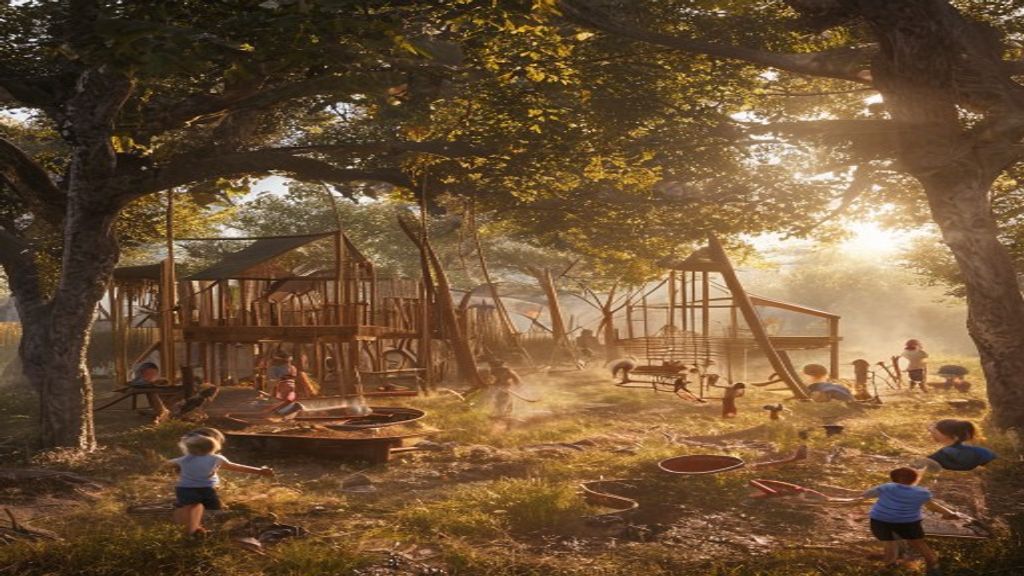
Monday has no meetings before noon. Instead there is an open field, a pile of loose parts, and an understanding: the morning belongs to whatever wants to happen. Some days it is a soccer game with rules that change every five minutes. Some days someone drags out a tarp and the whole thing becomes a slip-and-slide. Some days it is quiet — two people sitting in the dirt making something small out of clay. The point is not the activity. The point is the permission.
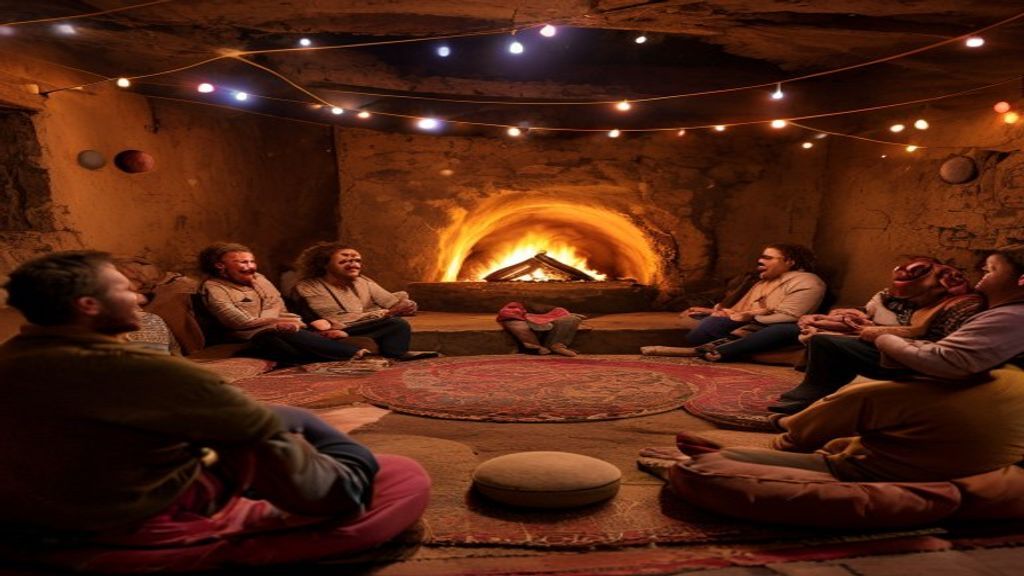
Tuesday nights are improv. Not a class. Not a performance. Just a circle of people saying yes-and to whatever absurdity someone throws into the room. A grandmother who once said she had no imagination now opens scenes that leave the room howling. The practice bleeds into everything — how conflicts are navigated, how ideas are proposed, how someone asks for help. Yes-and becomes the community's native tongue.
Saturday mornings, contact improvisation in the barn. No choreography, no teacher — just bodies learning to listen to other bodies through weight and momentum. A retired engineer discovers he can dance. A teenager who hates sports finds she loves this. Parkour happens whenever someone looks at a wall and sees an invitation instead of a boundary. The whole community is slowly becoming a playground — not because anyone designed it that way, but because play, once permitted, colonizes every surface.
What Nature Teaches
Dolphins invest up to eighty percent of their waking time in play. Not because they have leisure — because play is how intelligence happens. Social complexity, adaptive capacity, innovation under pressure — all of it built in the body through roughhousing, chasing, inventing games with seaweed and bubbles. The most successful species on Earth are the ones that never stop playing.
Young ravens slide down snow-covered roofs on their backs, climb to the top, and do it again. Otters juggle pebbles for no apparent reason. Octopuses disassemble their tanks and rearrange the parts. Play is not separate from adaptation. Play is how organisms keep discovering new ways to move with a world that keeps changing. The creature that stays playful is the one that can meet the river when it shifts.
In human children, pretend play — the kind where a stick becomes a horse and a cardboard box becomes a castle — exercises exactly the cognitive muscles needed for abstract thought, empathy, and inventive thinking. Adventure playgrounds, born in Denmark in the 1940s, proved that children given loose materials, real tools, and trust build things no adult architect would imagine. The key ingredient was not the materials. It was the absence of anyone telling them what to build.
Where You Can See It
At an adventure playground in London, a seven-year-old is sawing a plank in half. An adult stands nearby — not supervising, not helping, just present. The child's face holds total concentration. She has been working on this structure for three days. It leans. It will probably fall. She does not care. She is learning something no curriculum can teach.
In the Basque hills at Mondragon, workers on their lunch break play pelota against the factory wall — the same wall their grandparents played against. The game carries forward a kind of knowing about cooperation that no tending training ever will.
At a Baining fire dance in Papua New Guinea, adults leap through bonfires at night while the village watches and cheers. The flames are real. The intensity is real. The aliveness is so thick you can taste it. Play and ceremony merge when the stakes are high enough and the trust is deep enough. Nobody is performing. Everybody is alive.
What We're Building
An adventure playground as permanent infrastructure, not a weekend project. Loose materials replenished like groceries — wood, rope, tires, fabric, water, mud. A budget line that says play is as essential as plumbing.
Weekly improv nights where nobody performs and everyone plays. A monthly ridiculous games tournament where the rules are made up and the points do not matter. Contact improvisation sessions where dance belongs to every body. Parkour jams where every railing and wall becomes an invitation.
No productive purpose required. No outcomes measured. No justification needed.
Capoeira in the evenings for anyone who wants to feel what it is like when martial art, dance, music, and play become one thing. A ridiculousness budget — actual money set aside for things that serve no function except delight. The field that plays together stays adaptive, creative, bonded, and alive.
The Shapes Play Takes
Play is not one thing. It wears a hundred faces, and a living community needs room for all of them.
Body play. Running, climbing, wrestling, swimming, balancing, tumbling. The adventure playground is the anchor -- loose parts, real tools, real sensation. Children build and wreck and rebuild. Adults join when the urge hits. Rope swings over the pond in summer. Mud slides after rain. Parkour along every low wall and railing. The body that plays stays supple, and the community that plays together in the body trusts each other with weight and momentum and mess.
Imaginative play. The stick that becomes a sword. The cardboard box that becomes a fortress. Improv night is this for adults -- the practice of stepping into a story without knowing where it goes and saying yes to whatever arrives. Costume trunks in the common room, accessible to every age. A rule: any object in the community can become a prop, and no one gets in trouble for repurposing.
Social play. Games with shifting rules. The monthly ridiculous games tournament where someone invents a new game each time and the scoring makes no sense. Card games on the porch after dinner. The kind of teasing that only works when love is underneath it. Capoeira in the evenings -- martial art, dance, music, and play braided into one practice where nobody wins because the circle itself is the point.
Solitary play. The whittler on his bucket. The child arranging pebbles. The elder who does crosswords in the garden every afternoon. Play does not require company. Sometimes the deepest play is one person following their own fascination until the world falls away.
Spaces That Invite Play
A playground is not a structure -- it is a permission embedded in landscape.
The adventure zone. A quarter acre of loose material: lumber offcuts, tires, rope, fabric, pallets, barrels, pipes. Real hand tools hung at child height -- saws, hammers, drills. A mud kitchen with running water. No fixed equipment, because fixed equipment teaches fixed thinking. A covered area for rainy days. One adult present at all times, not supervising but available -- the way a lifeguard watches water.
The common room. Instruments on the wall. A costume trunk. Floor space big enough for contact improvisation, improv night, or an impromptu pillow fort. No furniture that cannot be moved. The room shape-shifts to match whatever play arrives.
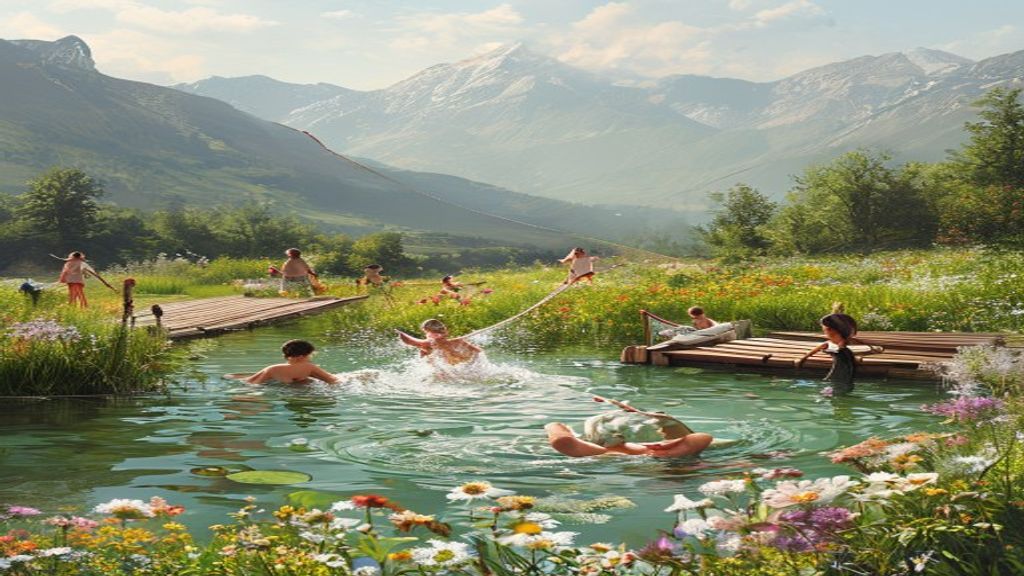
The outdoors. Every surface an invitation. Low walls at parkour height. Trees with branches that ask to be climbed. A slack line between oaks. A swimming hole with a rope swing. Paths that meander instead of connecting point A to B, because the meander is where play hides.
How Play Builds the Field
Play is not separate from the serious life of the community. It is where the community learns to be itself.
Conflict looks different when the people in the room did improv together last Tuesday. Someone who has caught you on a trust fall will disagree with you differently than a stranger will. The child who builds alongside adults all morning does not need a special program to feel belonging -- the belonging was built with the same hammer.
The ridiculousness budget is real money set aside for things that serve no function except delight. A giant slip-and-slide. Costumes for the goats on midsummer. Fireworks on someone's birthday because they said they always wanted fireworks. The budget says in numbers what the culture says in practice: play is not an extra. It is the foundation.
Resources
- The Art of Play — Playground Ideas, open-source playground designs for communities worldwide (type: guide)
- Adventure Playground Guide — Pop-Up Adventure Play, free resources for adventure play (type: guide)
- Flow Genome Project — research into flow states where play, peak performance, and fulfillment converge (type: guide)
- Permies.com — homesteading community with natural play and outdoor education forums (type: community)
- Reggio Emilia Approach — child-led learning through a hundred languages of expression (type: guide)
The Questions That Live Here
- How do adults recover the permission to be ridiculous?
- What happens to a community where play and work are not separate categories?
- How do you keep play alive when pressure builds and seriousness starts to win?
- What play structures serve both a five-year-old and a seventy-year-old?
- How do you integrate play into decision-making without trivializing the stakes?
Influences and connections
Listening for voices…
Connected Frequencies
The people, places, works, and concepts the graph shows connected to this one.