Language
Land Embedding
Living ExpressionThe field lives WITHIN a larger field. Like coral reef IS the ocean. The land is a cell in the field. Mutual nourishment.
The field lives WITHIN a larger field. Like coral reef IS the ocean. Custodianship, not ownership.
The Feeling
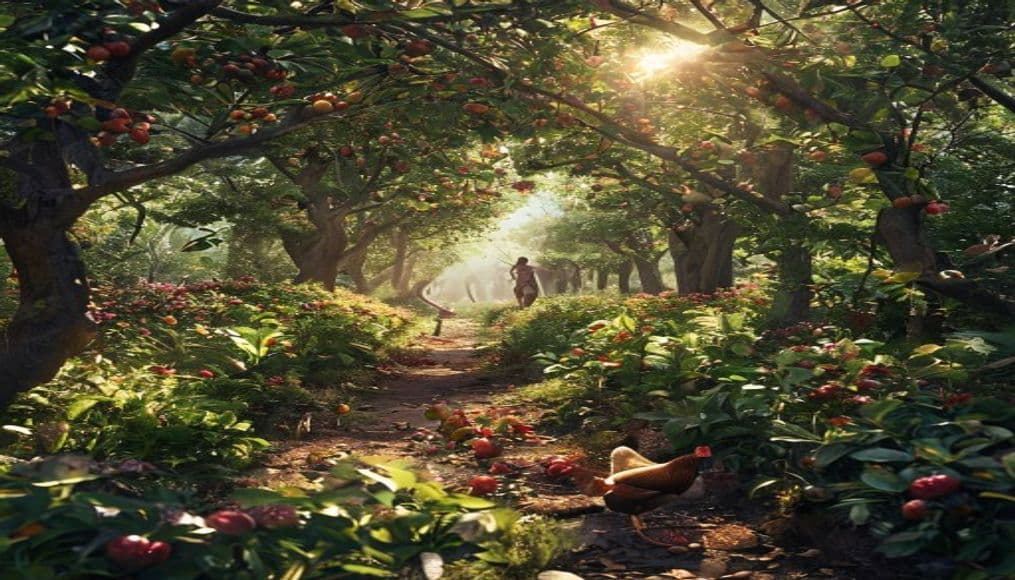
You walk out before dawn and the ground is cold under bare feet. Dew soaks through. You can feel the slope of the hill in your ankles, the way the land tips toward the creek. There is a smell -- not one smell but a conversation between wet clay, decomposing oak leaves, the iron tang of the spring, and something else you cannot name but that your body reads as home. Your lungs open wider than they do indoors.
Something in the soil knows you have been walking this path for three years now. The mycelial network under your feet is older than any human language and it is doing what it does -- connecting, feeding, signaling -- regardless of whether you notice. A teaspoon of healthy soil holds more microorganisms than there are people on earth. You are walking on a civilization.
By the third year you stop thinking of the land as a place you live on. It becomes a body you live within. You notice the swale you dug two summers ago is finally full -- the water table is rising. The willows you planted along the creek have woven a canopy so dense the kingfisher nests there now. You did not build this. You listened, and the land built itself around your listening.
The Aboriginal Australians have a word-concept for this depth of relationship: songlines, where the land is sung into existence, mapped through kinship rather than coordinates. Every ridge and waterhole has a story, a song, a connection stretching back sixty thousand years. The land is not a resource. It is a relative.
This is the frequency we reach toward -- knowing the land the way you know a body, feeling its health in your own bones.
How It Lives Here
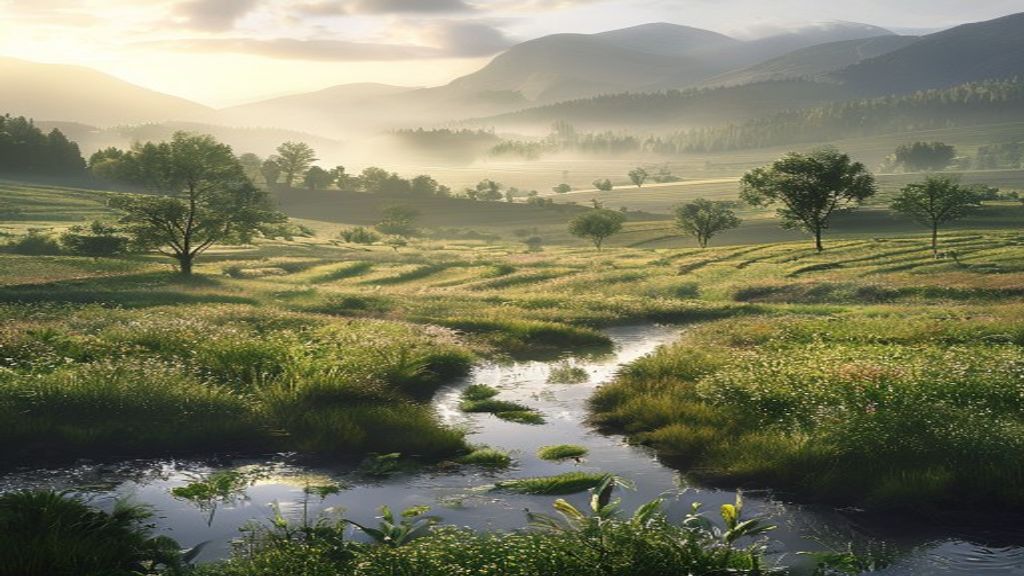
A Tuesday in September. The land council -- five people this month, rotating -- walks the whole property. They carry no clipboard. They walk slowly, pausing where the soil changes color, where a new spring seeps through limestone, where the deer have made a fresh trail through the hazelnut grove. One person kneels and pushes fingers into earth near the old erosion scar. The soil is dark now, alive with mycorrhizal threads. Three years ago this was bare red clay. Cover crops, compost, patience. The land healed itself once someone stopped hurting it.
At the monthly meeting, the council reports not in metrics but in stories. The spring near the eastern boundary is flowing stronger. The elderberry along the south fence is fruiting for the first time. Coyote tracks appeared near the chicken run -- time to reinforce the fence, but also a sign that the wildlife corridor is working. Predators follow prey and prey follows habitat and habitat follows water and water follows the contour swales that were dug by hand three winters ago. Everything connects.
Gaviotas, Colombia, proved this is not poetry. They regenerated eight million trees on barren savanna that experts called beyond recovery. Within twenty years, springs dry for decades began flowing. P.A. Yeomans discovered the same in Australia -- his keyline design reads the water patterns already written into the landscape and works with them. Ernst Gotsch's syntropic agroforestry in Brazil follows the forest's own logic: successional planting that mimics how an ecosystem builds itself.
What Nature Teaches
A coral reef does not sit in the ocean. It is the ocean -- the living edge where mineral becomes biology, where current becomes feeding, where a thousand species negotiate without a manager. The reef builds itself from the skeletons of its ancestors. It grows toward the light. It creates the conditions for more life than could exist without it.
The deepest teaching is about time. A forest thinks in centuries. A watershed thinks in millennia. When you plant five hundred trees in your first three years, you are beginning a conversation you will not live to finish. Your grandchildren will walk under canopy you will never see. This is custodianship -- the understanding that the land holds you as much as you hold it, and that when the community dissolves (if ever), the land returns to wildness, not to developers.
Every living system wants to become more complex, more diverse, more resilient. The role of the human is not architect but midwife -- creating conditions, removing obstacles, then stepping back. Our job is to rejoin the process already underway.
Where You Can See It
Tamera, Portugal -- once a dusty, dying landscape where springs had gone silent. Sepp Holzer's water retention landscapes brought them back. 170 people on 330 acres, demonstrating that even severely degraded Mediterranean land can be regenerated within fifteen years.
Greening the Desert, Jordan -- Geoff Lawton transformed dead salt flat into food forest in three years. The ground that was white with salt is dark with humus. Fig trees fruit where nothing grew.
Gaviotas, Colombia -- over 20,000 acres of regenerated savanna. The community produces its own energy, water, food, and building materials. The children swim in streams their grandparents never knew existed.
Auroville, India -- a barren red laterite plateau in 1968, now a forest of over two million trees sheltering three thousand residents from fifty nationalities. The aquifer has risen, biodiversity has returned.
Each place tells the same story: the land was waiting. It only needed someone to listen.
What We're Building
The legal structure removes the land from the market permanently -- Community Land Trust, conservation easement, or sovereign territory. The 99-year ground lease promises this soil will never become a parking lot. The conservation easement is a permanent covenant with the future. Over three hundred CLTs operate in the United States alone, and the model is well-tested and legally robust.
Before any earthworks, one full year of observation: water flow, sun patterns, wind, wildlife corridors, soil types. Walking every season, testing soil and water, meeting neighbors, learning the county's invitation. Then keyline water harvesting, five hundred trees in the first three years, wildlife corridors connecting to surrounding habitat. Every member is a custodian, not an owner. The land council walks the whole property monthly -- not to inspect but to listen.
The total cost for fifty people on natural-built land ranges from $580,000 to $4 million depending on region and ambition -- $11,600 to $79,400 per person, phased over three to five years. Funded by community shares, sweat equity, grants, and the social enterprises that emerge from surplus.
Practical guide: How to actually do this
Resources
- One Community - Open Source Village -- open-source blueprints for 7 village types
- Andrew Millison - Permaculture Design -- free textbook
- Grounded Solutions - CLT Startup Hub -- free CLT toolkit
- Brad Lancaster - Rainwater Harvesting
- Tamera Peace Research Village -- 330-acre demonstration
- Open Source Ecology -- 50 open-source machines at 1/8th cost
The Questions That Live Here
- How do you evaluate land before entering relationship with it -- water, soil, access, zoning, neighbors, history?
- What is the right ratio of land to people?
- How do you navigate rural zoning when the legal system has no category for "living within a larger living system"?
- What does it mean to inherit custodianship from people who practiced it for sixty thousand years?
- When does observation end and action begin -- or is observation itself the deepest form of action?
Influences and connections
Listening for voices…
Connected Frequencies
The people, places, works, and concepts the graph shows connected to this one.