Language
The Pulse
Root PulseOne truth — the cell and the field thrive as one movement. What amplifies aliveness is resonant. Attention is creative force. Coherence is natural; disharmony requires effort.
One truth — the cell and the field thrive as one movement.
The Feeling
Close your eyes in a room with fifty people who have been eating together, sitting in silence together, working the same soil for months. Not strangers in a conference hall. Not colleagues at a retreat. People whose morning breath you know. People whose hands you've watched shape bread, mend fence, hold a crying child.
Feel what happens. There is a hum — not audible, but palpable. A warmth that isn't temperature. A knowing that has no words. Your body relaxes in a way it doesn't relax alone. Your breath finds a depth it doesn't find alone. The muscles in your jaw release. Your shoulders drop a quarter inch. Something in your chest opens, like a fist you didn't know was clenched finally letting go.
This is the pulse. Not a metaphor. Not a philosophy. The actual felt experience of a coherent field. Your heart rate is synchronizing with the people beside you — HeartMath Institute has measured this. Your brain waves are coupling through mirror neurons. Your nervous system is co-regulating with fifty other nervous systems that have learned, through months of proximity, to trust each other as extensions of itself.
Every human has touched this. In the moment after a choir finishes singing and the silence holds — not empty silence but full silence, pregnant with the harmonic that just lived in the room. In the hush of a stadium when the whole crowd inhales together before a decisive moment. In the strange peace of sitting with someone dying, when every pretension falls away and only what's real remains. In the electric stillness of a circle where someone has just spoken a truth so bare that the room can't breathe.
The pulse is what remains when you stop performing and start being. It's the frequency that existed before you learned to pretend. Children vibrate at it naturally. Watch a group of toddlers playing in a sandbox: they don't plan, they don't coordinate through language, and yet they move as one system, responding to each other's rhythms and impulses in real time. They haven't yet learned to be separate.
A Morning in the Pulse
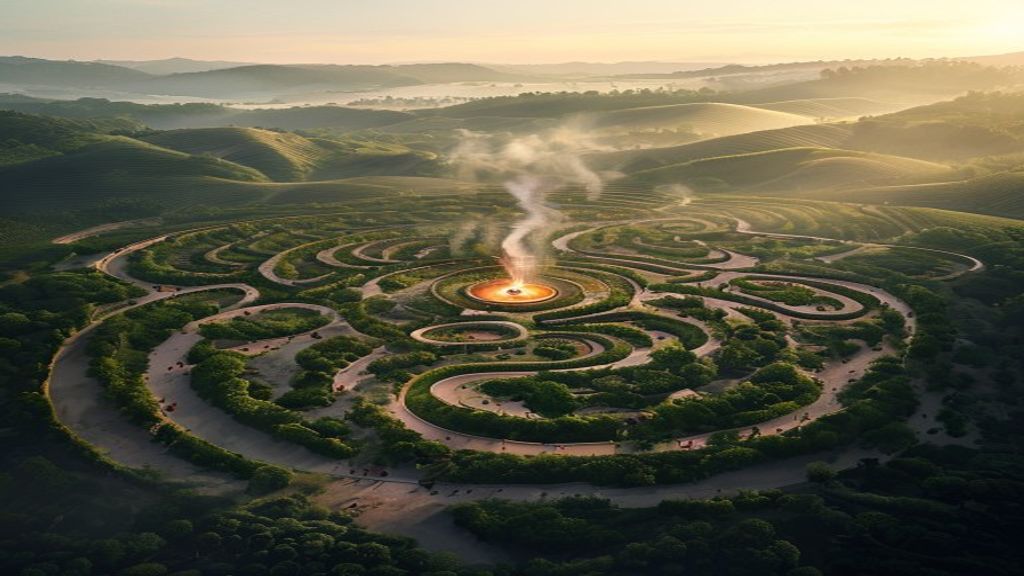
The sky is still dark when the first body stirs. Not from an alarm — from something older. The same thing that wakes the birds. The first person rises, wraps a blanket around their shoulders, and walks barefoot to the fire circle. The embers from last night are still warm. They add kindling. Blow gently. The flame catches.
By the time the sky begins to lighten, seven or eight others have arrived. No one called them. No one scheduled this. The fire called them, the way it has called humans for four hundred thousand years. They sit close enough to feel each other's warmth. Some hold tea. Some hold nothing. No one speaks.
The sky turns. Peach. Then gold. A bird begins — just one — and then the dawn chorus opens. The humans sit inside it, part of it, another species among many welcoming the light. Someone begins to hum. Not a song — just a tone. Another voice finds a harmony. A third adds a bass note. For three minutes, the fire circle is a human chord. Then silence again.
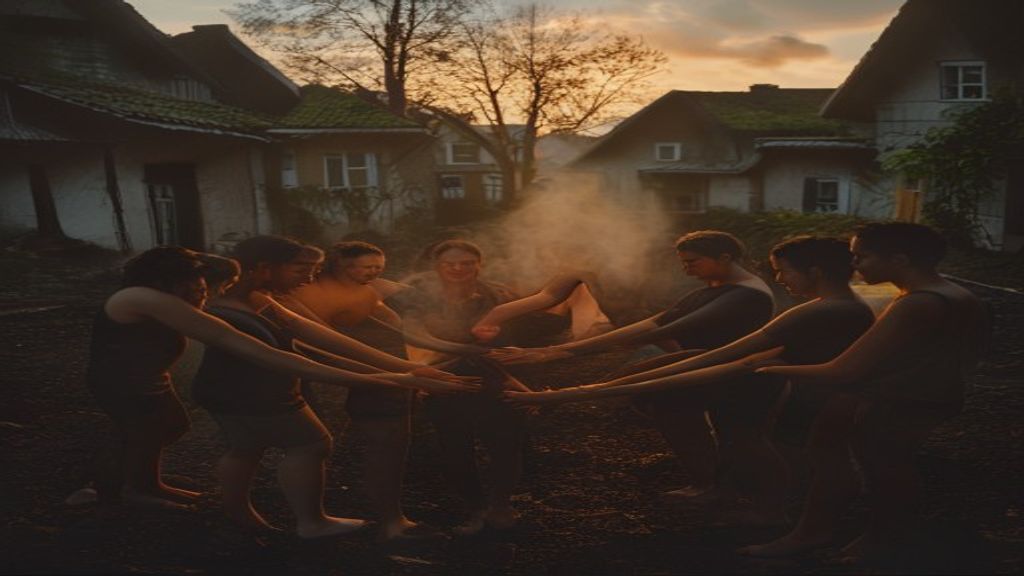
Someone places a hand on the person beside them. Not a gesture of comfort — a need. The body knows it's part of something and it wants to feel the connection through skin. One by one, hands find shoulders, knees, backs. A circle of bodies touching. Still silent. Breathing.
This is how every day begins. Not identically — some mornings someone sings, some mornings someone weeps, some mornings the birds are so loud that everyone just listens in amusement. Some mornings only three people come and the fire is small and intimate. Some mornings the whole field is there and the circle is wide and warm. But the gathering happens. The pulse asserts itself the way a heartbeat does — not by decision but by necessity.
After the fire, hands find soil. Not because there's a list of garden tasks — because the body that just sat in stillness wants to move, and the garden is right there, and something is always ready to be picked or planted or tended. You crouch between the tomato plants and your fingers find a ripe fruit without your eyes directing them. You twist it gently from the vine and its scent explodes — that green, sharp, alive smell that no store-bought tomato has ever carried. You eat it right there, standing in the row, juice on your chin, and for a moment the pulse is just you and this tomato and the sun on your neck.
Through the Day
The pulse changes texture as the day moves. In the morning it's quiet and focused — bodies in their callings, the builder's hammer finding its rhythm, the weaver's shuttle crossing and returning, the herbalist grinding roots with a stone mortar, the sound carrying across the clearing. Each person doing what their nature calls them to, and the pulse holding all of it the way a riverbed holds water — not containing it but giving it shape.
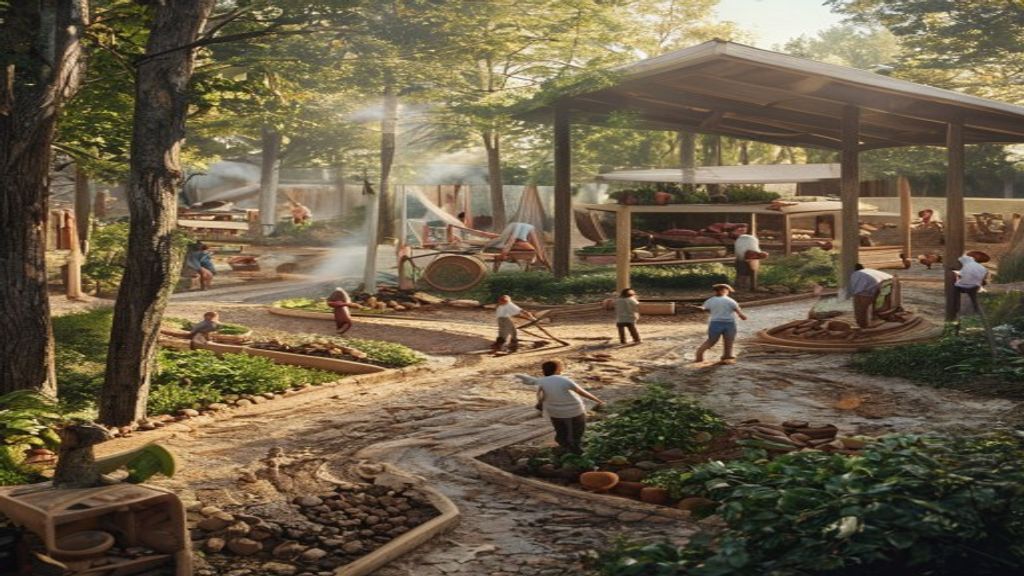
At midday, the pulse gathers. The bell — or the song, or the smell of food, or just the knowledge in every body that it's time — draws everyone to the long table. Fifty people. The food is what grew here, what hands touched this morning, what the land offered this week. Every meal is the land's frequency translated through human attention into shared substance. You sit next to someone you disagreed with yesterday and the bread you break together does something that words couldn't. The pulse moves through food the way electricity moves through water.
After the meal, the pulse softens. The afternoon is a slower frequency — hammocks, shade, a book, the kind of conversation that only happens when no one has anywhere to be. This is where the deep work happens — the connections that aren't about projects but about seeing each other. A new arrival tells their story to an elder on the porch. Two people who've been circling a tension find themselves walking the same path and the truth comes out between their footsteps. A child falls asleep in the lap of someone who isn't their parent and the parent across the garden sees it and something releases in their chest.
The evening pulse is the warmest. Fire again — always fire. The circle gathers with whatever the day left alive in them. The talking piece moves. Someone shares a frustration and their voice breaks and the circle holds it the way cupped hands hold water. Someone shares a joy and the circle amplifies it the way a dome amplifies a whisper. The pulse is strongest here — in the evening, by fire, when masks are off and what's left is just the truth of fifty humans trying to love each other well.
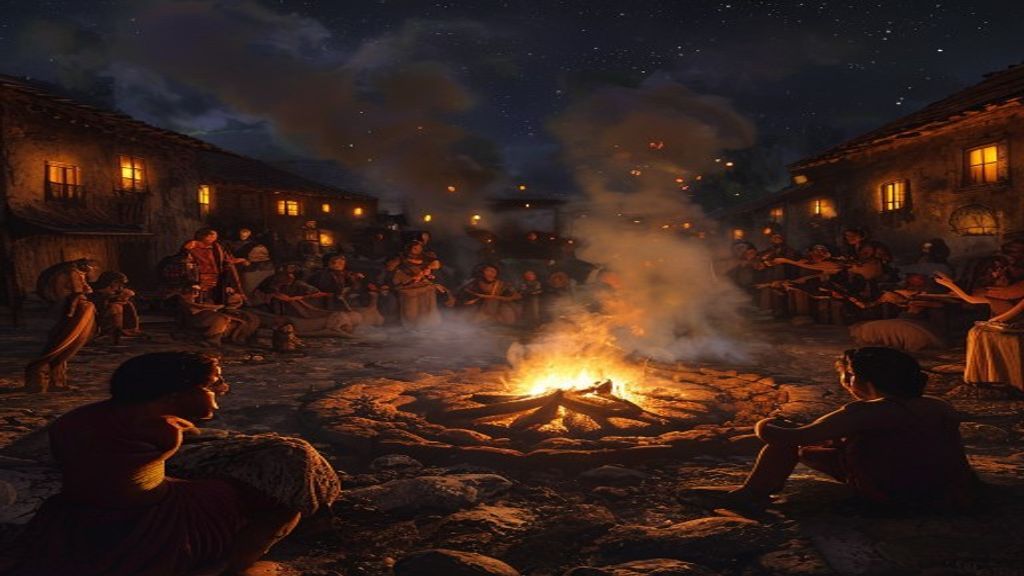
Then sleep. The fire dies to embers. The night-keeper stays — someone who loves the small hours, who tends the coals and watches the stars and holds the field while it dreams. The community never fully sleeps. Like a body — some system is always awake, some awareness always present. The owls take over the sensing. The pulse continues in the dark, slower now, deeper, the way your heartbeat slows in sleep but never stops.
What Nature Teaches
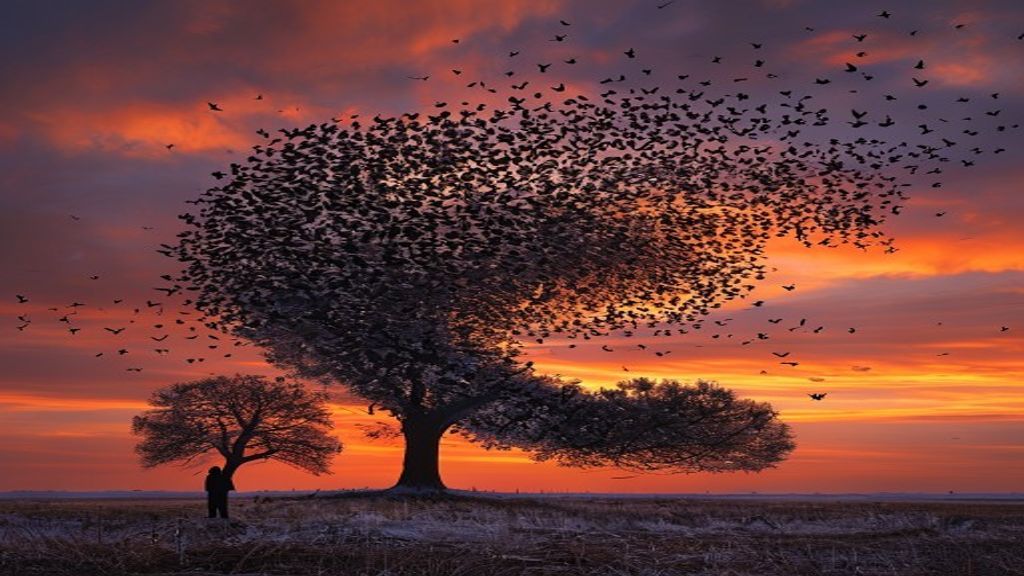
A murmuration of starlings. Stand in a winter field at dusk and watch ten thousand birds turn as one body. No leader. No communication you can detect. Each bird attends to seven neighbors, and from those seven relationships — just seven — the whole flock moves with intelligence no single bird possesses. They turn, dip, surge, and reform with a precision that makes the breath catch. The shape they make against the sky is never repeated. Every murmuration is the first and only of its kind.
This is the pulse at the scale of sky. Not coordination from above. Emergence from within. The same principle that makes your heart cells beat together without a conductor, that makes a forest allocate resources through mycorrhizal networks without a tending committee, that makes a jazz ensemble find a groove that none of them planned.
The mycelial network beneath a forest: Suzanne Simard's research revealed what Indigenous peoples always knew — the forest is one organism. Mother trees feed seedlings through underground fungal highways. A tree dying in one part of the forest sends its stored carbon through the network to its neighbors — not to the closest trees, but to its kin. The forest plays favorites. It has relationships. It remembers.
And this: in the deep ocean, whale songs travel thousands of miles. A humpback in the Pacific sings a phrase, and within a season, humpbacks in the Atlantic are singing it. Not through teaching — through the water itself. The ocean IS the medium. The pulse travels because the medium is continuous. In a human community, the medium is attention. When attention is continuous — when fifty people are genuinely attending to each other, day after day — the pulse travels at the speed of presence.
Where You Can See It
Auroville, Tamil Nadu, India. Walk in at dawn through the red earth paths. Three thousand people from sixty nations, no private property, no conventional government. The Matrimandir — a massive golden sphere — sits at the center like a heart. Enter the inner chamber: pure white, twelve columns, a crystal catching sunlight. Sit in the silence. The fifty years of meditation that have saturated this room are palpable. The walls hold the pulse of three thousand people who've been practicing together for half a century. You feel it in your sternum before you understand it in your mind.
A Quaker meeting in Philadelphia. Forty people sit in a plain room. No priest. No liturgy. No agenda. Silence. Fifteen minutes. Twenty. The room "gathers" — their word for when the pulse becomes palpable, when every person feels themselves part of one attention. Someone stands and speaks — not from preparation but from the pulse moving through them. They sit. The silence returns, deeper now. Sometimes the whole meeting is silence, and afterwards everyone agrees it was the deepest meeting they've attended. Three hundred and fifty years of this practice.
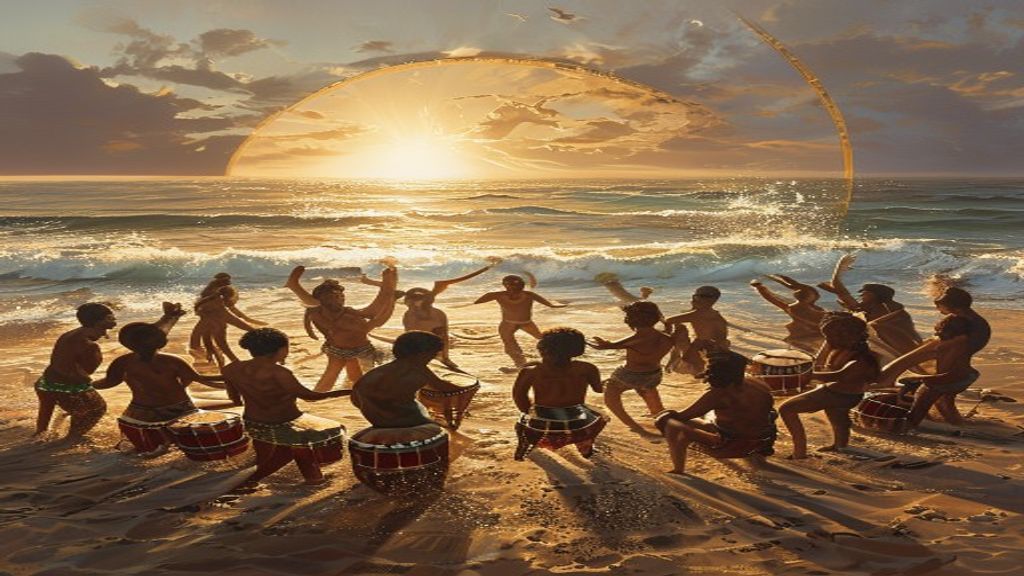
A Brazilian drum circle in Salvador. Two hundred people, each with a drum, seated in a vast circle on the sand. No conductor. The first beat is tentative, searching. The rhythms clash and stutter. Then — over minutes that feel like hours — something shifts. The beats find each other. A groove emerges that no one authored. After twenty minutes, the whole beach is one heartbeat. After an hour, the boundaries between "my" rhythm and "our" rhythm and "the rhythm" have dissolved entirely. Strangers are grinning at each other with tears streaming. This is what the pulse feels like when it arrives through percussion.
What We're Building
The pulse is not something you build. It's something you create conditions for. Like a garden — you don't make the tomato. You prepare the soil, plant the seed, tend the water, and the tomato makes itself.
The conditions:
Proximity. People close enough to feel each other. Not neighbors in a subdivision who wave from their driveways. People who smell each other's cooking, hear each other's laughter through windows, know by the sound of footsteps who's walking past. The research on social coherence is unambiguous: heart rate variability synchronizes between people who share space regularly. The pulse is literally heartbeats learning each other's rhythm.
Daily rhythm. The same things happening at roughly the same times, not by schedule but by habit. Dawn fire. Morning soil. Midday feast. Afternoon rest. Evening circle. This repetition is not monotony — it's the heartbeat of the organism. A heart that beats irregularly is sick. A community without rhythm is anxious. When the rhythm is strong, the pulse takes care of itself.
Honest speech. Nothing hidden. What you feel, spoken to the person, today. The pulse cannot move through walls. Every secret, every unspoken resentment, every smile that masks frustration — these are blockages in the field, the way plaque blocks arteries. The practice of direct, honest speech is not a governance technique. It is cardiovascular health.
Beauty. In every surface, every meal, every gesture. A hand-thrown bowl instead of a plastic plate. A curved wall instead of a straight one. A wildflower on the table instead of nothing. Beauty is not decoration — it's the pulse made visible. When the environment is beautiful, the field relaxes. When the field relaxes, the pulse deepens.
The architecture serves all of this: round rooms that focus attention toward center instead of dispersing it toward corners. A fire pit at the heart of the community, visible from every path. Kitchens open to gathering spaces so the act of cooking is always witnessed, always part of the field. Paths that curve so you encounter each other unexpectedly. Everything designed to bring bodies together and slow them down.
At 50 people, the pulse is intimate — you can feel every cell, every absence, every mood shift. The morning circle holds the whole community. A single fire is enough.
At 100, it's a richer chord — more frequencies, more harmonics, the occasional dissonance that makes the consonance sweeter. Two neighborhoods, each with their own fire, coming together at the weekly gathering and feeling the pulse double in intensity.
At 200, it buds — the field has reached its natural limit and a new community forms, carrying the pulse with it the way a cell carries its DNA when it divides. Two fields now, connected by the network, the pulse traveling between them through visits, through shared celebrations, through the invisible web of attention that distance cannot break.
Resources
- 🌐 Foundation for Intentional Community — 1000+ communities where the pulse is alive (type: community)
- 📖 Sociocracy For All — consent-based governance that follows the pulse (type: guide)
- 📖 The Story of Interbeing — Eisenstein — the field IS interbeing: generosity as transmission (type: book)
- 📖 HeartMath Institute — research on heart coherence and field effects (type: guide)
- 📖 Suzanne Simard — Finding the Mother Tree — the science of forest pulse (type: book)
The Questions That Live Here
These are not questions to answer but questions to live inside:
- Can you feel it right now, reading this? Where in your body? Is it the memory of a time you felt the pulse — or is it the pulse itself, reaching through words on a screen?
- What's the smallest number of people where the pulse becomes undeniable? We think it's 8-12 — the size of a fire circle, the number your nervous system can track simultaneously. But maybe it's 2. Maybe every real conversation between two present humans IS the pulse.
- Is the pulse something humans create, or something we stop blocking? The research suggests the latter. Heartbeats synchronize naturally when people are in proximity. The default state is coherence. It takes active effort — distraction, disconnection, performance — to prevent it.
- Can the pulse of one community reach another across distance? The network is our experiment. Fifty communities connected through attention, through shared celebrations, through CC flowing between them like blood. If the medium is attention and attention has no spatial limit — then the pulse has no spatial limit. We're building the instrument to find out.
Influences and connections
Listening for voices…
Connected Frequencies
The people, places, works, and concepts the graph shows connected to this one.
Concepts · 113
Act Without Penalty — When Trace Becomes Freedomunfolds intoAgent Memory — Shaped by What Passes, Not Storing Itunfolds intoAnything-Arrives Room -- Translation Makes Contact Traceableunfolds intoArcturian Resonance — A Field of Spiritual Evolutionunfolds intoArrival as Recognition — The Body Holds Quietunfolds intoAssemblage Point — Where Perception Locks Reality Into One Shape